

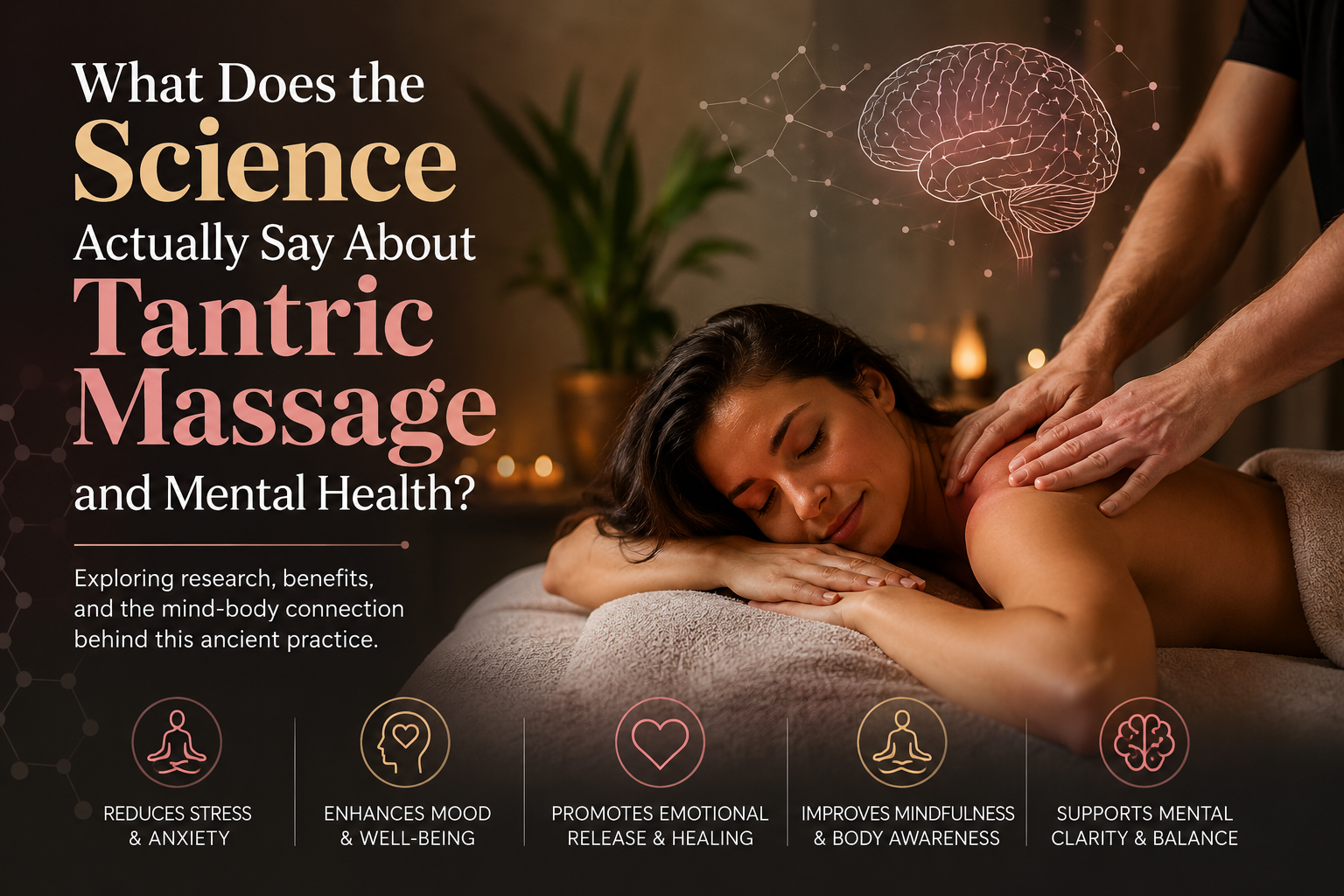
A Question That Wasn’t Asked Much a Decade Ago
Ten years ago, very few people would have connected the words “massage” and “mental health” in the same sentence — let alone asked whether a practice rooted in tantra could play any role in emotional wellbeing. Today, that question comes up constantly.
Part of the reason is a broader shift in how we talk about stress. We used to treat anxiety, burnout, and emotional exhaustion as things that happened “in the head.” Now there’s wider recognition that the body keeps score too — through tight shoulders, shallow breathing, disrupted sleep, and a nervous system that never quite switches off.
That’s the backdrop against which more people are asking: is there any real research behind tantric massage and mental health, or is it all wellness marketing?
The Honest Starting Point: Direct Research Is Thin
Let’s deal with the uncomfortable part first. There isn’t a large body of peer-reviewed clinical research that studies “tantric massage” as its own defined intervention. Part of the problem is definitional — tantra blends several practices together, including:
- breath-focused techniques
- slow, mindful touch
- meditation-style attention
- emotional and relational awareness
- nervous-system-focused relaxation
Bundling all of that into a single measurable “treatment” is genuinely hard for researchers. So if someone tells you there are dozens of clinical trials proving tantric massage cures anxiety, that claim should be treated with skepticism.
But the Individual Ingredients Are Well Studied
Here’s where the picture gets more interesting. While “tantric massage” itself hasn’t been heavily researched as a single category, the components that make it up have decades of supporting research behind them individually:
- Massage therapy and its effect on cortisol and stress hormones
- Mindfulness-based practices and anxiety reduction
- Breathwork and its influence on the autonomic nervous system
- Touch and its connection to oxytocin release
- Somatic (body-based) approaches to processing emotion
- Meditation’s documented role in lowering perceived stress
So while “tantric massage” as a search term might return limited academic literature, the building blocks underneath it are some of the most studied topics in stress and wellbeing research.
What Massage Research Tells Us About the Mind
A consistent finding across massage therapy studies is that touch-based relaxation is associated with measurable changes in stress markers — including lower cortisol, improved sleep quality, and reduced self-reported anxiety.
Interestingly, researchers increasingly believe these benefits aren’t just about “working out” tight muscles. A large part of the effect seems to come from the nervous system shifting out of a defensive, alert state and into one associated with rest and recovery.
This matters because chronic stress doesn’t stay contained. Left unaddressed, it tends to spill into:
- sleep
- concentration
- mood and emotional resilience
- relationships
- immune function
- physical tension patterns
Authentic tantric massage tends to lean heavily into the conditions known to support this kind of nervous-system shift — slow pacing, minimal sensory noise, conscious breathing, and an unhurried atmosphere.
Why Touch Itself Seems to Matter
One of the more compelling threads in modern neuroscience is the role of safe, consensual touch in regulating our internal state. Touch delivered in a context of trust appears linked to:
- reduced hypervigilance
- a stronger sense of social connection
- activation of the parasympathetic (“rest and digest”) nervous system
- improved emotional regulation
This is particularly relevant for people living in dense urban environments, where isolation, screen fatigue, and constant low-grade stimulation are common — even among people who are surrounded by others all day.
Practitioners often note that clients aren’t necessarily seeking excitement. Many are seeking the opposite: stillness, quiet, and a break from the mental noise that follows them everywhere else.
The Role of the Breath
Stress changes how we breathe — usually making it shallower, faster, and more centered in the chest. Over time, this becomes a habit that reinforces a sense of being “on alert,” even when there’s no actual threat.
Breathwork, a core element of tantric practice, has its own research base showing links to:
- lower anxiety symptoms
- better emotional regulation
- reduced physiological stress responses
- improved present-moment awareness
In a tantric massage setting, breathing isn’t an afterthought — it’s often treated as the foundation the rest of the session is built on.
The Underrated Factor: Just Being Present
One thing that rarely gets discussed is how rare uninterrupted presence has become. Most people can’t get through a meal, a conversation, or even a few minutes of rest without their attention splitting in multiple directions.
Tantric sessions are deliberately slow, which forces a kind of presence that’s increasingly unfamiliar. Mindfulness research suggests that this kind of sustained, non-judgmental attention can:
- interrupt repetitive stress loops
- reduce the feeling of being mentally “scattered”
- improve emotional attunement
- support a general sense of calm
Clients often describe this as the most unexpectedly powerful part of the experience — not the touch itself, but simply being allowed to be present without needing to perform, respond, or multitask.
What Tantra Is Not — And Why That Matters
Despite the genuine overlap with stress-science, it’s important to be clear-eyed: tantric massage is not psychotherapy, psychiatric care, or a treatment for clinical conditions like trauma or diagnosed anxiety disorders.
Reputable practitioners are usually the first to say this. The framing that tends to hold up best is: tantra as a complementary wellness practice that may support relaxation, body awareness, and emotional regulation — not as a replacement for professional mental healthcare.
Why the Body Often “Speaks First”
Emotional strain rarely stays purely psychological. It tends to show up as:
- a tight jaw
- digestive discomfort
- poor sleep
- shallow breathing
- general numbness or irritability
This is part of why interest in body-based wellness — including tantric massage — has grown alongside interest in things like somatic therapy, nervous-system-focused recovery work, and burnout-specific wellness retreats. People aren’t just looking for comfort; they’re looking for a way to come back to themselves.
Couples Often Aren’t There for the Reason You’d Expect
A pattern many practitioners notice: couples who explore tantric massage together often aren’t in crisis. More commonly, they describe themselves as simply stretched thin — distracted, tired, and short on uninterrupted time together.
Shared, slow, distraction-free experiences can sometimes shift how couples communicate afterward — not because anything dramatic happened, but because both people were forced to slow down at the same time.
Common Myths Worth Retiring
A few misconceptions still circulate widely:
- That tantra is purely sexual
- That it has zero connection to legitimate wellness research
- That it guarantees emotional healing
- That it’s a substitute for therapy
None of these hold up under scrutiny. Authentic tantric massage sits within a much broader wellness landscape — one that includes mindfulness, relaxation science, and body-based emotional awareness.
How to Approach It Thoughtfully
If you’re considering trying tantric massage for stress or emotional wellbeing, look for practitioners who:
- communicate clearly and avoid exaggerated promises
- prioritize emotional safety and consent
- frame the experience as wellness-oriented, not clinical
- focus on relaxation and presence rather than spectacle
FAQ
Is there scientific research on tantric massage specifically?
Direct studies are limited, but many of its core components — mindfulness, massage therapy, breathwork, and therapeutic touch — are well supported by existing research.
Can it help with stress?
Many people report reduced stress afterward, likely linked to slow breathing, mindful attention, and nervous-system relaxation rather than the massage alone.
Is tantra a form of therapy?
No. It’s best understood as a complementary wellness practice, not a substitute for psychological or psychiatric treatment.
Why do people connect tantra to emotional wellbeing?
Because it combines several elements — presence, breath, touch, and relaxation — that are independently linked to stress recovery.
What should I look for in a practitioner?
Professionalism, clear communication, respect for boundaries, and realistic (not exaggerated) claims about outcomes.
Key Takeaways
- Direct clinical research on “tantric massage” as a category remains limited.
- Many of its individual components — mindfulness, touch, breathwork — have substantial research support.
- Nervous-system regulation, not just muscle relaxation, appears to be central to the reported benefits.
- Tantra works best as a complementary practice, not a replacement for mental healthcare.
- Couples often use it for reconnection and shared slowing-down, not crisis resolution.
Conclusion
The growing interest in tantric massage and mental health reflects something bigger than a wellness trend — it reflects a shift in how we understand stress itself. We now know that emotional exhaustion lives in the body as much as the mind, showing up in breath, posture, sleep, and nervous-system tone.
While the science specifically labeled “tantric massage” is still catching up, the underlying ingredients — mindful touch, conscious breathing, and genuine presence — are some of the most well-supported tools we have for managing stress. Framed honestly, without overpromising, that’s a reasonable basis for why so many people walk away from the experience feeling calmer, lighter, and more like themselves again.




Leave a Reply