

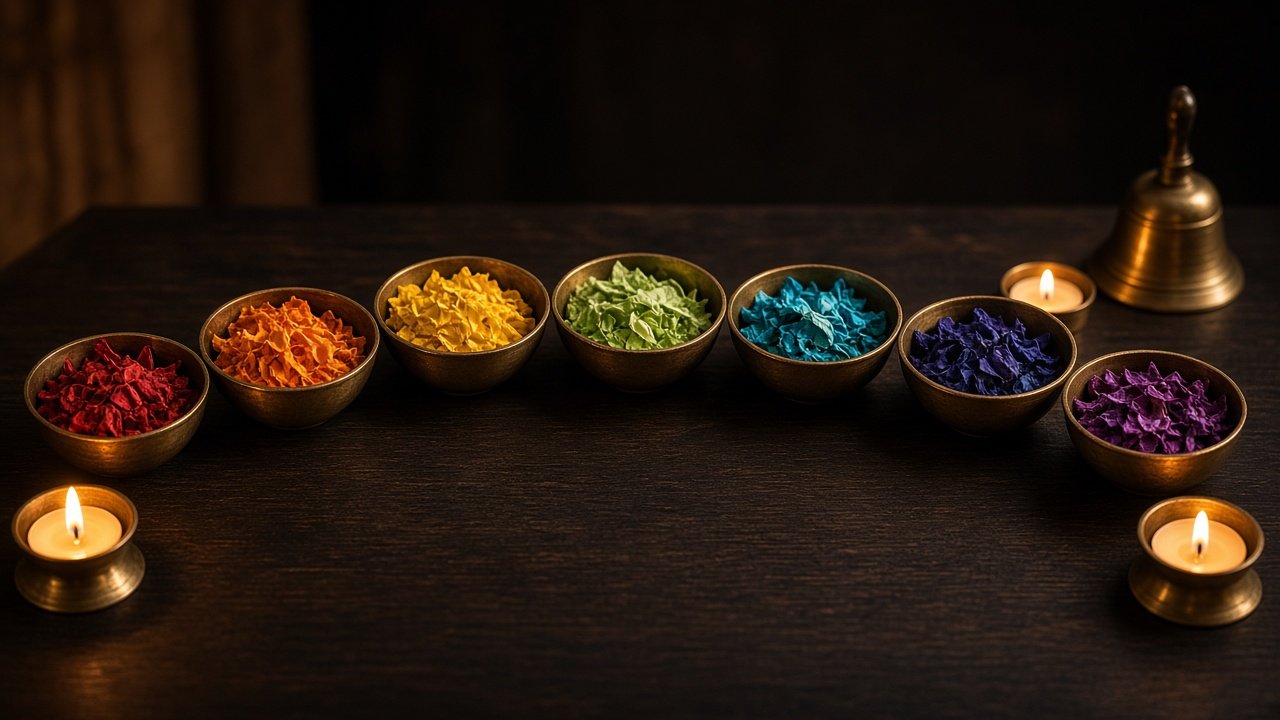
The seven-chakra model is probably the most recognisable image in modern yoga culture: a vertical line of coloured wheels from the base of the spine to the crown of the head. It is easy to treat the diagram as a finished piece of ancient science. It is more accurate, and more interesting, to see it as a meditation map that grew over centuries within Tantric traditions and then was reshaped by twentieth-century translators and teachers.
This article walks through the seven chakras one at a time, explaining the traditional associations, the qualities modern teachers attach to each, and how each can be used as a focus for gentle reflection. It is a practical, non-medical introduction. Nothing here is a diagnosis, and no chakra is claimed to cause or cure illness.
A note on sources and variation
Before the tour, a few points of honesty.
Reference works describe how Tantrism developed an esoteric anatomy of energy centres, called chakras, linked by channels, and how this anatomy is visualised in Tantric yoga. But the number of chakras varies between texts, and the details of names, colours, petals, seed sounds and locations differ between lineages. The popular seven-chakra rainbow owes much to a twentieth-century English translation of a sixteenth-century Sanskrit text, and many psychological associations are modern additions.
None of this makes the system useless. It means that you should hold specific claims lightly and treat the model as a framework for attention rather than as literal anatomy.
How to use this guide
For each chakra, you will find:
- The traditional name and rough location.
- The element commonly associated with it (for the lower five).
- Typical themes that teachers explore.
- A short reflection or body-awareness practice.
You can work through them in a single sitting, but it is often more rewarding to spend a week on each. Keep sessions gentle and brief, and stop if anything feels uncomfortable.
1. Muladhara: the root
Location. The base of the spine and pelvic floor region.
Name. Mula means root and adhara means support.
Element. Earth.
Themes. Stability, safety, belonging, the basic sense of being supported. Teachers often connect this centre to feelings of security and to practical matters like home, health and finances.
Traditional seed sound. LAM.
Reflection. Sit or stand and feel your contact with the ground. Notice weight and support. Ask: where do I feel secure in my life, and where do I feel shaky? Walk slowly, feeling each footstep.
When it might help. If you feel scattered, anxious about practical matters or ungrounded, spending time on earth-like practices can help you feel steadier. This is a reflective tool, not a treatment.
2. Svadhisthana: the sacral centre
Location. The lower abdomen, below the navel.
Name. Often translated as “one’s own abode.”
Element. Water.
Themes. Flow, feeling, creativity, pleasure, adaptability. Modern teachers often link it to how we relate to emotion and enjoyment.
Traditional seed sound. VAM.
Reflection. Place a hand on the lower belly. Breathe softly. Notice any sense of fluidity or tension. Try slow, flowing movements of the hips or torso. Ask: where do I allow myself enjoyment, and where do I hold back?
When it might help. When you feel rigid, driven or cut off from feeling, softening practices may help you notice what you have been bracing against.
3. Manipura: the solar plexus
Location. The upper abdomen, around the navel.
Name. Often translated as “city of jewels.”
Element. Fire.
Themes. Energy, will, confidence, digestion and drive. Teachers link it to how we assert ourselves and take action.
Traditional seed sound. RAM.
Reflection. Rub the palms until warm and rest them over the upper belly. Notice warmth and the movement of breath. Ask: where do I act with clarity and where do I hesitate or overreach? Set one small, clear intention.
When it might help. If motivation is low or, conversely, if you are overdriving, noticing the quality of “fire” can help you adjust.
4. Anahata: the heart
Location. The centre of the chest.
Name. Often translated as “unstruck,” a reference to a subtle inner sound.
Element. Air.
Themes. Connection, compassion, openness, relationship. Teachers link it to how we give and receive care.
Traditional seed sound. YAM.
Reflection. Rest a hand on the chest. Feel the heartbeat and breath. Bring to mind someone you care about and notice any sensations in the chest. Ask: where am I open in my relationships and where am I guarded?
When it might help. In times of loneliness or conflict, simple practices of kindness can help. If grief or difficult feelings arise, proceed gently and seek support if needed.
5. Vishuddha: the throat
Location. The throat and neck.
Name. Often translated as “especially pure.”
Element. Space.
Themes. Expression, truthfulness, listening and communication.
Traditional seed sound. HAM.
Reflection. Hum quietly and feel vibration in the throat and chest. Notice whether the throat is tight or relaxed. Ask: what do I need to say, and what do I need to hear? Practise one honest, kind statement today.
When it might help. If you struggle to express yourself or find yourself talking over others, attention to this centre can prompt reflection.
6. Ajna: the brow
Location. Between and slightly above the eyebrows.
Name. Means “command” or “perception.”
Element. In many schemes, no gross element, as it is associated with mind and intuition.
Themes. Insight, clarity, imagination and discernment.
Traditional seed sound. Often OM.
Reflection. Close the eyes and rest attention gently at the forehead, without straining. Notice stillness or subtle sensation. Ask: what do I see clearly right now, and where am I confused? Avoid pressing or crossing the eyes.
When it might help. When thinking feels cluttered, a few minutes of quiet attention at this point can help settle the mind.
7. Sahasrara: the crown
Location. The top of the head, or the space just above it.
Name. Means “thousand-petalled.”
Element. None; associated with pure awareness.
Themes. Openness, spaciousness, unity and the sense of being part of something larger.
Traditional seed sound. Silence, or OM.
Reflection. Rest attention at the crown and let it widen to the space above and around you. Notice the sense of being aware. Ask: what is it like to rest without trying to achieve anything?
When it might help. When the mind is busy, resting in openness can be a quiet counterbalance.
The channels linking the centres
The chakras are not isolated. Tantric descriptions emphasise channels called nadis, with three particularly important ones running along the spine: ida, pingala and sushumna. Practices often involve imagining or sensing movement along the central channel. These ideas deserve their own articles, but it is worth knowing that the chakras are usually presented as nodes in a network rather than as separate wheels.
The philosophy underneath
Why would a tradition build such a detailed map of the body? The nondual philosophy of Kashmir offers a clue. A commentary on a classic Shaiva text explains that energy and awareness are never apart, and that engaging with energy can be a path into stillness. The chakra map gives that insight concrete places to explore. Each centre becomes a doorway into the same underlying awareness, reached through different qualities of experience.
That is also why the system has been adapted so widely. Anything that organises bodily attention and invites reflection can be useful, and the seven-centre model is memorable and easy to teach.
Combining the chakras into a single short practice
Once you have explored each centre, you can combine them in a simple ten-minute sequence that moves from the base upward and then back down.
- Settle with three slow breaths and a sense of contact with the seat.
- Ascend slowly. Spend three or four breaths at each of the seven locations, resting attention lightly without trying to produce any sensation.
- Rest at the crown for a minute, feeling the space above and around the head.
- Descend slowly, letting attention move back down through the body to the base, as though settling into the ground.
- Widen to the whole body, then take a deeper breath and open the eyes.
The descent is not a formality. In many traditions, return and grounding are treated as important as ascent, because they integrate whatever has been noticed into ordinary life. If you feel light-headed or spacey after practice, spend extra time on the lower centres: feel your feet, eat something and move around.
Everyday uses of the framework
The chakra themes can serve as simple prompts during the day. When you feel insecure, ask what would help you feel more supported. When you feel stuck, ask where you could allow more flow. When you feel unmotivated, ask what small, clear action you could take. When you feel disconnected, ask whom you could reach out to. When you feel unheard, ask what you need to say. When you feel confused, ask for a minute of quiet. When you feel overwhelmed, ask what it would be like to rest in a wider view.
Used this way, the system becomes a compact set of questions rather than a belief system. It nudges you toward a response that is practical and kind.
Questions to hold while you explore
As you work with each centre, a few open questions can keep the practice honest. What do I actually feel here, as opposed to what I expect to feel? Does this theme resonate with my life, or does it feel imposed? What changes when I stay with it for a few more breaths? If I dropped the vocabulary entirely, what would remain? Writing short answers keeps the exploration grounded in experience and protects against the habit of simply matching your feelings to a list.
Cautions
No medical claims. Descriptions linking specific chakras to specific diseases lack scientific support. Please consult a health professional for health concerns.
Avoid rigid typing. Statements such as “you have a blocked heart chakra” can be unhelpful labels. Treat them, at most, as prompts for self-reflection.
Go gently with intense practices. Strong breath work, prolonged visualisation or practices aimed at dramatic energy experiences are best learned from qualified teachers.
Be wary of commercial pressure. Expensive “chakra healing” packages, crystals or readings are not required for practice.
A week-by-week plan
If you want to explore systematically, try one chakra per week for seven weeks.
| Week | Centre | Daily five-minute practice |
|---|---|---|
| 1 | Root | Feel ground contact; slow walking |
| 2 | Sacral | Flowing movement; hand on lower belly |
| 3 | Solar plexus | Warm palms; small clear intention |
| 4 | Heart | Hand on chest; kind attention to someone |
| 5 | Throat | Humming; one honest sentence a day |
| 6 | Brow | Quiet attention at forehead |
| 7 | Crown | Open awareness; rest without goals |
Write a few lines after each session. At the end, review which centres were easiest to feel and which themes were most relevant. You may find that the exercise teaches you as much about your habits of attention as about the chakras themselves.
Studying in context
The chakras make most sense when learned alongside philosophy, breath and meditation. If you want to explore their place in Tantric thought, a structured Tantra course can offer that wider context. The Academy of Modern Tantra publishes an introduction to what it understands Tantra to be and describes its teaching as drawing on tradition while acknowledging modern developments. As with any provider, read the course details, ask about teachers’ training, and be wary of exaggerated claims.
The takeaway
The seven chakras are best understood as a meditation map: a way of organising attention along the central axis of the body and exploring different qualities of experience. Their modern form is a layered inheritance, shaped by Tantric traditions, early twentieth-century translation and contemporary teaching.
You do not have to accept every claim to benefit from the exercise. Take the locations as resting places for attention, take the themes as prompts for reflection, and take your own experience as the final test. Used that way, the system can be a quiet, practical companion to everyday life.











Leave a Reply