
Why So Many People Misunderstand Tantra Today
Few wellness concepts are as misunderstood as Tantra.
For some people, the word immediately evokes mystery, spirituality, or intimacy. Others associate it with modern wellness spas, mindfulness retreats, or luxury relaxation experiences. And increasingly in cities like London, many encounter Tantra through the growing popularity of tantric massage London wellness services.
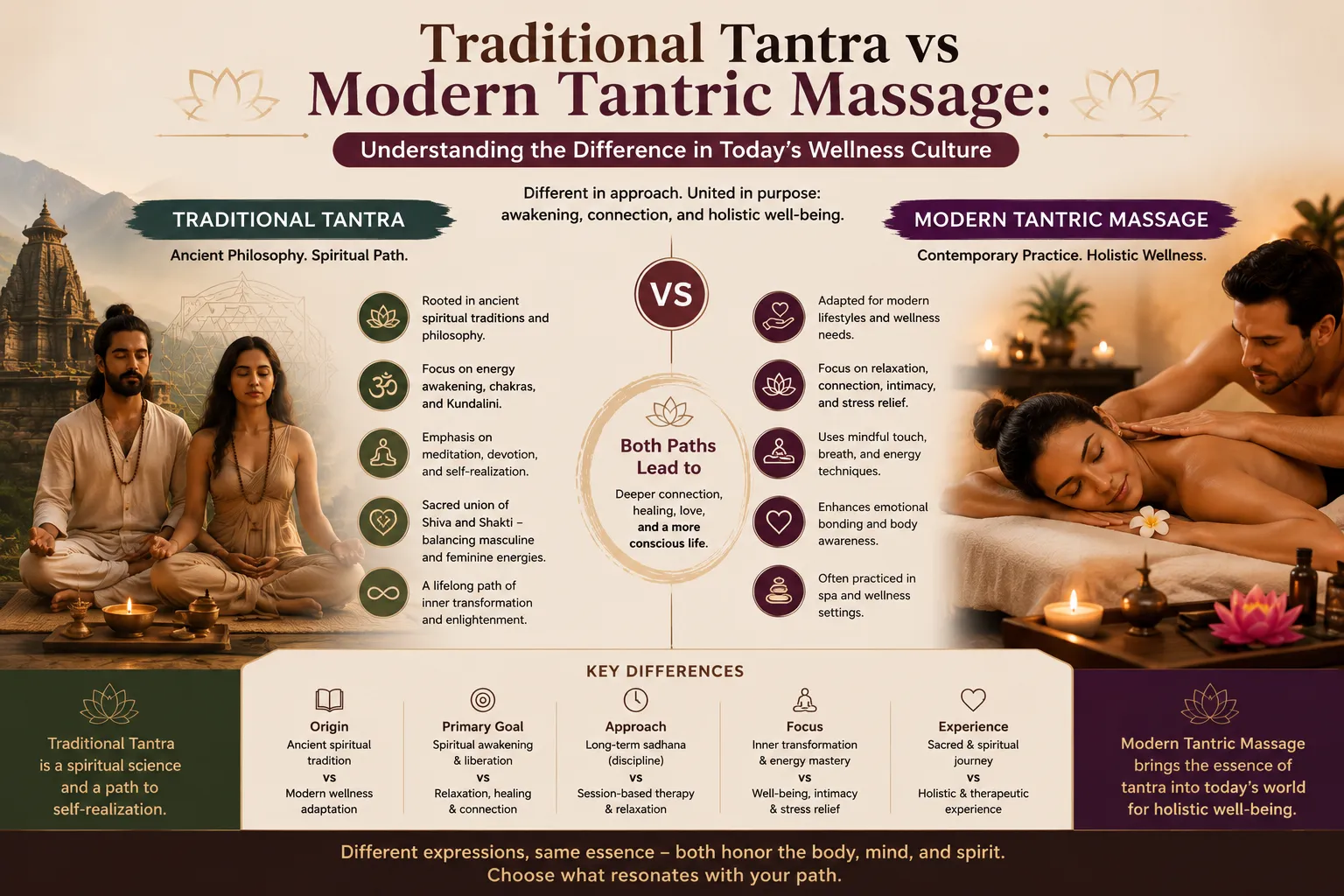
Yet traditional Tantra and modern Western tantric massage are not the same thing.
They overlap in certain ideas — particularly mindfulness, presence, breath awareness, and human connection — but they emerged from very different cultural and historical contexts.
Understanding this distinction matters because modern conversations about Tantra are often oversimplified. Ancient spiritual philosophy becomes reduced to internet stereotypes, while modern wellness adaptations are frequently misunderstood altogether.
In reality, traditional Tantra was never simply a massage practice. It was a broad philosophical and spiritual system concerned with consciousness, awareness, balance, energy, ritual, meditation, and human experience itself.
Modern tantric massage, meanwhile, has evolved into a wellness-oriented relaxation experience shaped by contemporary mindfulness culture, luxury wellness trends, and the growing modern need for emotional decompression.
The two are connected — but they are not identical.
What Traditional Tantra Originally Meant
Traditional Tantra emerged centuries ago within spiritual traditions connected to parts of India and surrounding regions.
Historically, Tantra was not designed as a commercial wellness treatment or spa experience. It was a philosophical and spiritual framework focused on expanding awareness and understanding the relationship between:
- mind
- body
- breath
- consciousness
- ritual
- meditation
- human energy
- spiritual presence
Ancient tantric traditions often included:
- meditation practices
- breathwork
- visualization
- ceremonial rituals
- mindfulness disciplines
- spiritual teachings
- sacred symbolism
- teacher-student transmission
The purpose was transformation through awareness.
Rather than separating physical experience from emotional or spiritual experience, Tantra explored how human awareness could become more integrated and conscious.
Importantly, traditional Tantra was highly diverse. Different schools and traditions approached these ideas in different ways. Some were deeply meditative and philosophical. Others incorporated rituals, movement, chanting, or symbolic practices.
But in most historical contexts, Tantra was never solely about physical touch or massage.
That modern interpretation came much later.
How Tantra Became Associated With Modern Wellness
The modern Western interpretation of Tantra evolved gradually over decades, particularly as mindfulness culture, alternative wellness practices, yoga movements, and holistic therapies became more mainstream.
As interest in emotional wellbeing and sensory awareness expanded, some practitioners began adapting selected tantric ideas into wellness-focused relaxation experiences.
Over time, this evolved into what many people now recognize as tantric massage.
Modern tantric healing massage typically emphasizes:
- mindfulness
- breath awareness
- emotional relaxation
- sensory calmness
- body awareness
- nervous-system relaxation
- immersive wellness environments
Rather than functioning as a spiritual doctrine, modern tantric massage usually operates as a therapeutic-style wellness experience designed to help people decompress physically and emotionally.
This distinction is important because many individuals searching for tantric massage in London today are not necessarily looking for ancient religious teachings. More often, they are searching for:
- emotional calmness
- mindful relaxation
- luxury wellness experiences
- sensory stillness
- stress reduction
- restorative body awareness
The practice has become part of modern wellness culture rather than a direct continuation of historical Tantra itself.
Traditional Tantra Focused on Consciousness — Modern Tantric Massage Focuses on Relaxation
One of the clearest differences between traditional Tantra and contemporary tantric massage is intention.
Traditional Tantra often pursued:
- spiritual awareness
- expanded consciousness
- ritual understanding
- meditative presence
- philosophical insight
- energetic balance
Modern tantric massage usually focuses on:
- relaxation
- emotional decompression
- mindfulness
- stress relief
- sensory awareness
- calming therapeutic experiences
This difference reflects broader cultural shifts in how modern society approaches wellness itself.
Today, many people are overwhelmed not by lack of information, but by constant stimulation.
Modern life creates:
- emotional fatigue
- nervous-system overload
- digital exhaustion
- chronic stress
- disconnection from stillness
- difficulty slowing down
As a result, modern wellness practices increasingly prioritize experiences that help people feel grounded, calm, and mentally present again.
This is why contemporary tantric massage often appeals to individuals seeking something more immersive than a standard spa treatment.
Why Modern Urban Life Changed Wellness Expectations
In cities like London, stress rarely feels purely physical anymore.
People often carry:
- cognitive overload
- emotional fatigue
- constant digital engagement
- interrupted rest
- overstimulation
- pressure-driven lifestyles
Traditional wellness treatments can certainly help reduce muscular tension. But many people now want wellness experiences that address the emotional side of exhaustion as well.
This cultural shift explains the rise of:
- mindfulness retreats
- breathwork practices
- sensory wellness therapies
- meditation-focused wellness
- immersive relaxation rituals
- holistic body-awareness treatments
Modern tantric massage exists within this broader movement toward emotionally intelligent wellness experiences.
For many people, the attraction lies not in intensity — but in slowness.
A chance to experience calm without urgency.
Why People Often Confuse Tantra With Sensuality
One reason Tantra is frequently misunderstood is because internet culture tends to simplify complex ideas into provocative stereotypes.
In reality, traditional Tantra was a vast spiritual philosophy, while modern tantric massage is usually positioned within holistic wellness and relaxation culture.
Of course, human touch itself can feel emotionally powerful. Mindfulness, breath awareness, sensory stillness, and emotional comfort naturally create experiences that feel deeply personal and restorative.
But reducing Tantra entirely to sensuality ignores its broader philosophical and psychological dimensions.
Many modern wellness-focused practitioners instead emphasize:
- mindfulness
- emotional grounding
- body awareness
- stress reduction
- calming environments
- respectful communication
- therapeutic pacing
This distinction matters increasingly because modern wellness audiences are becoming more discerning. People are seeking experiences that feel:
- emotionally intelligent
- calming
- restorative
- respectful
- psychologically supportive
rather than performative or sensationalized.
The Rise of Mindful Wellness Experiences in London
The popularity of authentic tantric massage experiences reflects a larger transformation happening across luxury wellness culture.
Modern wellness is becoming less about indulgence alone and more about nervous-system restoration.
People increasingly seek experiences that help them:
- disconnect mentally
- slow overstimulation
- improve emotional balance
- reconnect with physical awareness
- create moments of intentional calm
This explains why many luxury wellness environments now integrate:
- mindfulness
- aromatherapy
- breathwork
- sensory relaxation
- meditative pacing
- emotionally calming environments
The atmosphere itself has become part of the therapy.
For many clients exploring tantric massage London services, the appeal is often the feeling of finally slowing down in a world that rarely pauses.
Traditional Spiritual Philosophy vs Modern Therapeutic Adaptation
Perhaps the most accurate way to understand the relationship between traditional Tantra and modern tantric massage is this:
Modern tantric massage is not a recreation of ancient Tantra.
It is a modern wellness adaptation influenced by certain tantric ideas such as:
- mindfulness
- conscious awareness
- breath connection
- presence
- sensory attention
- emotional grounding
The goals, however, are often very different.
Ancient Tantra explored consciousness and spiritual transformation.
Modern tantric wellness experiences usually focus on:
- relaxation
- emotional wellbeing
- calming overstimulation
- immersive mindfulness
- restorative stillness
Understanding this distinction allows people to approach both subjects with greater clarity and respect.
Why Emotional Relaxation Has Become So Important
One of the most interesting shifts in modern wellness culture is the growing recognition that relaxation is not only physical.
Many people today struggle more with:
- emotional overstimulation
- inability to disconnect
- constant mental activity
- nervous-system fatigue
- emotional exhaustion
than with physical discomfort alone.
This explains why mindfulness-oriented wellness experiences continue growing worldwide.
People are searching for experiences that help them feel:
- mentally lighter
- emotionally grounded
- physically calm
- psychologically present
A full body relaxation experience often becomes valuable not because it solves one specific problem, but because it temporarily quiets the constant noise modern life creates internally.
Final Thoughts
Traditional Tantra and modern tantric massage are connected through ideas of awareness, mindfulness, and presence — but they are fundamentally different practices shaped by very different historical and cultural purposes.
Traditional Tantra emerged as a spiritual and philosophical system concerned with consciousness and human awareness.
Modern tantric massage evolved as a contemporary wellness experience focused on relaxation, emotional calmness, mindfulness, and sensory wellbeing.
Understanding this distinction helps remove much of the confusion surrounding Tantra today.
And perhaps that clarity matters now more than ever.
Because in a world defined by speed, stimulation, and emotional overload, many people are no longer searching simply for treatments.
They are searching for experiences that help them slow down, breathe deeply, reconnect with themselves, and experience moments of genuine stillness again.
That deeper emotional need is ultimately why tantric wellness continues resonating so strongly within modern luxury wellness culture.
FAQs
What is the difference between traditional Tantra and tantric massage?
Traditional Tantra was a spiritual and philosophical system focused on consciousness and awareness, while modern tantric massage is generally a wellness-focused relaxation experience emphasizing mindfulness and emotional calmness.
Is tantric massage based on ancient Tantra?
Modern tantric massage is influenced by some tantric concepts such as mindfulness, presence, and breath awareness, but it is not identical to traditional tantric philosophy.
Why is tantric massage popular in London?
Many people in London seek immersive wellness experiences that help reduce stress, emotional fatigue, and overstimulation from modern urban life.
Is tantric massage considered a wellness therapy?
Many contemporary practitioners position tantric massage within holistic wellness, mindfulness, sensory relaxation, and luxury spa culture.
What do people seek from authentic tantric massage experiences?
People often seek emotional relaxation, body awareness, mindfulness, calming atmosphere, and restorative wellness experiences.




Leave a Reply