
Ritual is the part of Tantra that modern readers most often skip, and the part that traditional practitioners would say they cannot do without. Where popular books tend to focus on breath, energy or philosophy, the classical Tantric traditions were built around structured, repeatable actions: reciting mantras, drawing diagrams, placing sacred sounds on the body, visualising deities and receiving initiation from a teacher.
This article explains what ritual does in traditional Tantra Yoga, introduces the main elements in plain terms, looks at how scholars understand the symbolism, and discusses what, if anything, can sensibly be borrowed by people practising in a secular modern setting. It is an explanation of how the tradition works, not a set of instructions. Several of the practices described below are traditionally taught only after initiation and under personal guidance, and that is an important part of how they are meant to be learned.
Why ritual sits at the centre
Encyclopedic accounts of Tantra emphasise that its main focus is developing the practitioner’s dormant psychophysical powers through special meditation and ritual techniques, transmitted personally from master to initiate. In other words, ritual is not decoration around the philosophy. It is the method.
There is a logic to this. If you believe that body, mind, sound and world are all expressions of one consciousness, then it makes sense to work with all of them at once. A ritual is a way of engaging the whole person, body through gesture, voice through mantra, mind through visualisation, in a single sustained act of attention. A purely mental practice leaves much of that unused.
Another reason is that ritual gives structure. The traditions treat Tantric knowledge as powerful and potentially disorienting, so practices come inside frameworks of preparation, sequence and closure. A ritual has a beginning, a middle and an end, which protects the practitioner from drifting.
The main building blocks
Mantra
Mantra is sacred sound. In Tantric ritual, a mantra is more than a verbal formula. It is regarded as the form of a deity or principle in sonic shape, and repeating it is a way of making that principle present. A modern summary of the Kashmiri tradition describes mantra as reflexive speech, sound that traces its way back to the silence from which it arises.
Mantra practice ranges from silent repetition to elaborate chanting. In many lineages, particular mantras are given by a teacher at initiation, and the manner of repetition, including the number, posture and accompanying visualisation, is specified.
Yantra
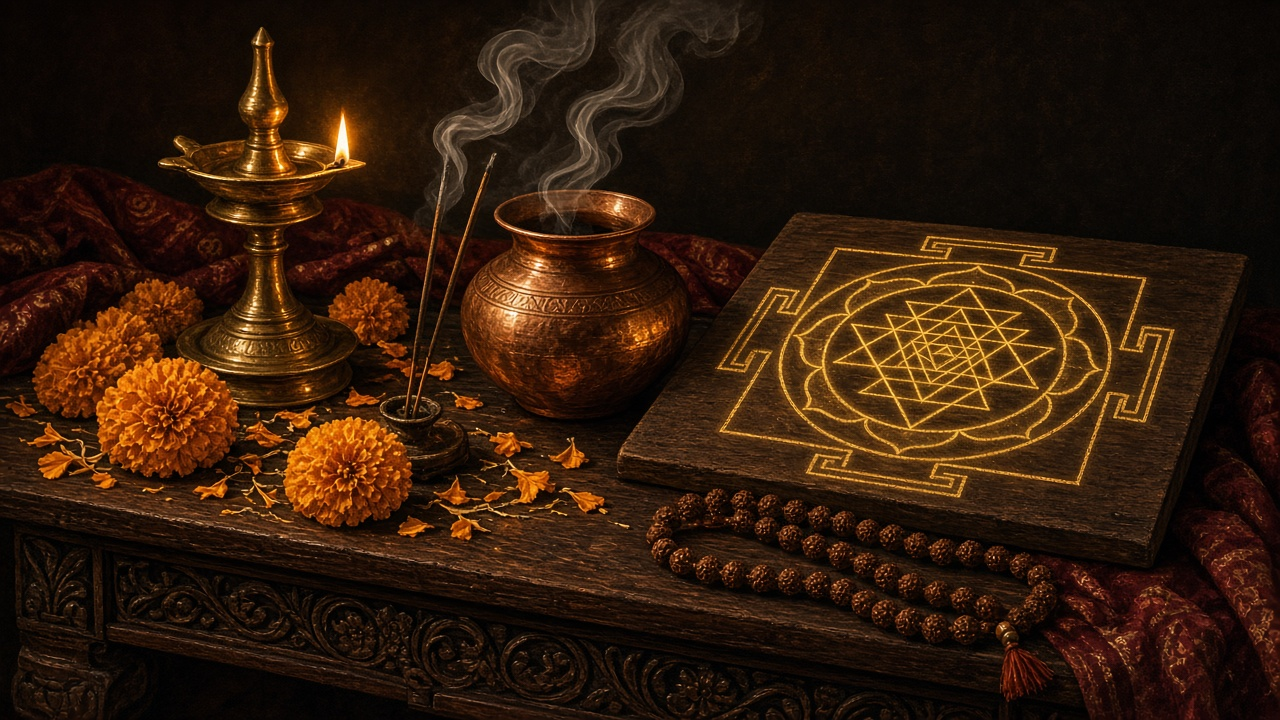
A yantra is a geometric diagram, often built from interlocking triangles, circles and lotus petals, used as a visual support for meditation and worship. One definition from a Hindu purana describes worship carried out with a combination of tantra, yantra and mantra, noting that a yantra is a mystical diagram regarded as possessing special powers. Traditionally, such a diagram is treated as a map of the cosmos or of a deity’s presence, and the practitioner learns to move attention inward through it.
Visualisation
Another core element is visualisation: forming a detailed, vivid mental image of a deity, a diagram or a pattern of light. Scholars of Tantric visual culture have approached this through cognitive science, treating images as tools for training perception and attention. The point is not fantasy but disciplined imagination, holding a complex image steady and allowing it to transform the practitioner’s sense of self.
Nyasa: placing sacred sound on the body
One of the most distinctive Tantric practices is nyasa, a technique in which the practitioner touches different parts of the body while reciting a mantra and visualising a deity or an aspect of one. A glossary description explains that its purpose is to “divinise” the body, turning it into a sacred space that holds the divine presence.
The mantra is the link between sound and body. As it is placed on each area, the sacred syllables become located in specific parts of the body. Some forms are simple, and others are elaborate enough to amount to inscribing a diagram on the body. The glossary lists several common variants:
- Kara nyasa, placing mantras on the hands.
- Anga nyasa, placing mantras on regions of the body.
- Vyapaka nyasa, placing mantras across the whole body.
- Matrika nyasa, placing the fifty phonemes of the Sanskrit alphabet, called the “mothers,” on the body.
- Pitha nyasa, identifying the body with the seat of the chosen deity.
Nyasa shows clearly why ritual and body-based yoga belong together. The body is not merely the site of the practice. It is treated as the sacred instrument and the temple.
Mudra and gesture
Hand and body gestures, called mudras, often accompany mantra and visualisation. Some seal energy, others express an attitude or offering. In hatha yoga, the term also covers certain internal practices, which is one of the ways ritual vocabulary carried over into the posture and breath traditions.
Worship, or puja
Many Tantric rituals are forms of worship: offering flowers, light, incense, water or food to a deity, whether in an image, a diagram or the practitioner’s own body. These are familiar in broader Hindu religious life, and Tantric versions often add specific inner visualisations and mantra sequences.
Initiation: the gate
A recurring feature across lineages is initiation, in Sanskrit diksha. An account of Kashmir Shaivism notes that since it is a Tantric tradition, a necessary prerequisite for its yogic practice is initiation. Initiation is both a ritual and a relationship. It establishes the teacher as a living channel for the tradition, authorises specific practices and, according to the traditions themselves, awakens something in the student that books cannot.
For modern readers this raises an obvious point. If a practice is described as requiring initiation, reading about it, or following a video, is not the same as receiving it. Some practices are not meant to be done outside such a context, and a reputable teacher will say so plainly.
How scholars read the symbolism
Tantric ritual is full of imagery that can look startling out of context, including skulls, cremation grounds, fierce deities and, in some texts, transgressive acts. How should these be understood?
Scholars give different answers. A major Indian historian of the subject notes that traditionalists interpret the sexual and transgressive elements as “purely symbolical,” while others see them as “appliedly symbolical,” and that the elements in question are minimal compared with the vastness of the subject. Reference works on the Shakta Tantras confirm that some texts treat so-called left-hand practices, including ritual copulation, alongside other texts devoted almost entirely to ritual or even magic. The traditions themselves are internally varied, and a single reading will not cover them all.
A careful approach for modern readers is to avoid two extremes. One is to treat everything as harmless metaphor and ignore how the texts present themselves. The other is to treat the most sensational passages as the essence of the tradition. The more responsible reading is that a small part of the literature uses shocking imagery, that much of it is symbolic or restricted to initiated practitioners, and that the majority of Tantric ritual is devotional, meditative and philosophical.
What the ritual is meant to do
Taken together, the elements above serve several purposes in the tradition.
Transforming identity. Visualising oneself as a deity, or placing mantras on the body, is a way of loosening the habitual sense of being a limited, separate person. The practitioner rehearses a larger identity until it becomes familiar.
Training attention. Holding a detailed image, a long mantra or a precise sequence is demanding. The ritual structure trains concentration in a way that vague meditation often does not.
Integrating the senses. Sound, sight, touch, scent and movement all participate, which makes the experience more complete than a purely mental exercise.
Creating sacred space and time. Ritual frames a stretch of time as different from ordinary life, which can make deeper attention easier.
Embedding a lineage. Performing a practice the way teachers have performed it for generations connects the individual to a continuous tradition.
An example of how a ritual is structured
Without describing any specific initiated practice, it is possible to outline the general shape that many traditional rituals share, because the pattern itself is instructive.
- Preparation. The practitioner purifies the space and themselves, often through washing, a short mantra or a few moments of settling breath. The aim is to mark a clear boundary between ordinary activity and the practice.
- Invocation. The practitioner brings to mind the deity or principle that the ritual is directed toward. This may involve visualisation, a mantra or an offering.
- Central practice. The core of the ritual unfolds: sustained repetition, visualisation, worship or meditation, depending on the tradition.
- Offering and dedication. The practitioner offers the results of the practice, often by dedicating any benefit to a wider purpose.
- Closing. The ritual ends with a deliberate return to ordinary awareness, which prevents the practitioner from carrying heightened states abruptly back into daily life.
This pattern of preparing, entering, practising, offering and closing is useful even outside a religious context. Many modern meditation and bodywork teachers use a similar rhythm without the theology, because it helps people feel contained and safe.
Why embodiment is built into the rituals
Another reason ritual matters is that it keeps practice from turning into abstraction. Because gesture, sound and touch are part of the act, a practitioner cannot meditate only in the head. Even a simple ritual such as placing a hand on the heart while reciting a short phrase brings the body into the picture. This fits the broader Tantric view, noted earlier, that the body is a primary instrument of the path rather than an obstacle to it. It also explains why courses that call themselves Tantric often include movement, breath and touch-free body awareness alongside discussion.
What can sensibly be borrowed
Most people reading this are not looking to enter a traditional lineage. Is there anything in the logic of ritual that can help a modern, secular practitioner? There is, so long as the borrowing is honest.
Create a simple frame. Set aside a regular time and place for practice, and mark its beginning and end with a small, consistent gesture such as a breath, a bow or lighting a candle. This reproduces the structural function of ritual without importing doctrines.
Use sound deliberately. Humming, a simple word repeated slowly, or listening to a bell all the way to silence can bring some of the benefits of mantra practice. These are general attention exercises rather than traditional mantra initiation.
Practise body awareness with touch. Placing a hand on a part of the body and breathing into it for a few cycles echoes the body-as-sacred-space idea, in a purely secular form.
Use imagery gently. Imagining warmth spreading through the body or picturing a calm place is a mild cousin of visualisation. Stop if the imagery brings up distress.
Respect the difference. If you find yourself performing something that is labelled as an initiated practice, ask who authorised you to do it and what the tradition says about doing it without that context.
These suggestions are general reflections, not clinical advice. People with trauma histories or mental health conditions should take extra care with intense breath, imagery or body-focused practices and consider guidance from a qualified professional.
Ritual, wellbeing and modern courses
A great deal of contemporary Tantra-inspired teaching has quietly redesigned ritual for modern audiences. Rather than long ceremonies, there are short opening and closing rhythms, guided body-awareness sequences and reflective exercises. Whether this counts as faithful adaptation or dilution is a matter of continuing debate, and the answer varies by provider.
If your interest is broader wellbeing rather than the specifics of any lineage, a holistic wellness course that includes mindfulness, breath and body awareness may be a sensible, low-pressure place to start. If you are drawn to the yoga side of the tradition, a structured Tantra Yoga programme can show you how a provider approaches practice in a modern setting. The Academy of Modern Tantra describes its Tantra Yoga offering as drawing on tradition while supported by contemporary science. In either case, look at the curriculum, ask how rituals and practices are presented, and check that boundaries, consent and personal choice are treated as basics.
The takeaway
In traditional Tantra Yoga, ritual is not an optional extra. It is the method by which philosophy becomes practice: mantra gives sound to attention, yantra and visualisation give it form, nyasa brings it into the body, worship gives it devotion and initiation gives it a living line of transmission. The aim, according to the traditions, is a gradual transformation of the practitioner’s sense of self and world.
For modern readers, the sensible path is neither to imitate rituals one has only read about nor to dismiss them as superstition. It is to understand what they are for, borrow the underlying principles of structure, sound, embodiment and sustained attention where appropriate, and seek proper guidance for anything that belongs to a lineage. That approach respects the tradition and protects the student, and it is a good way to begin.






Leave a Reply