

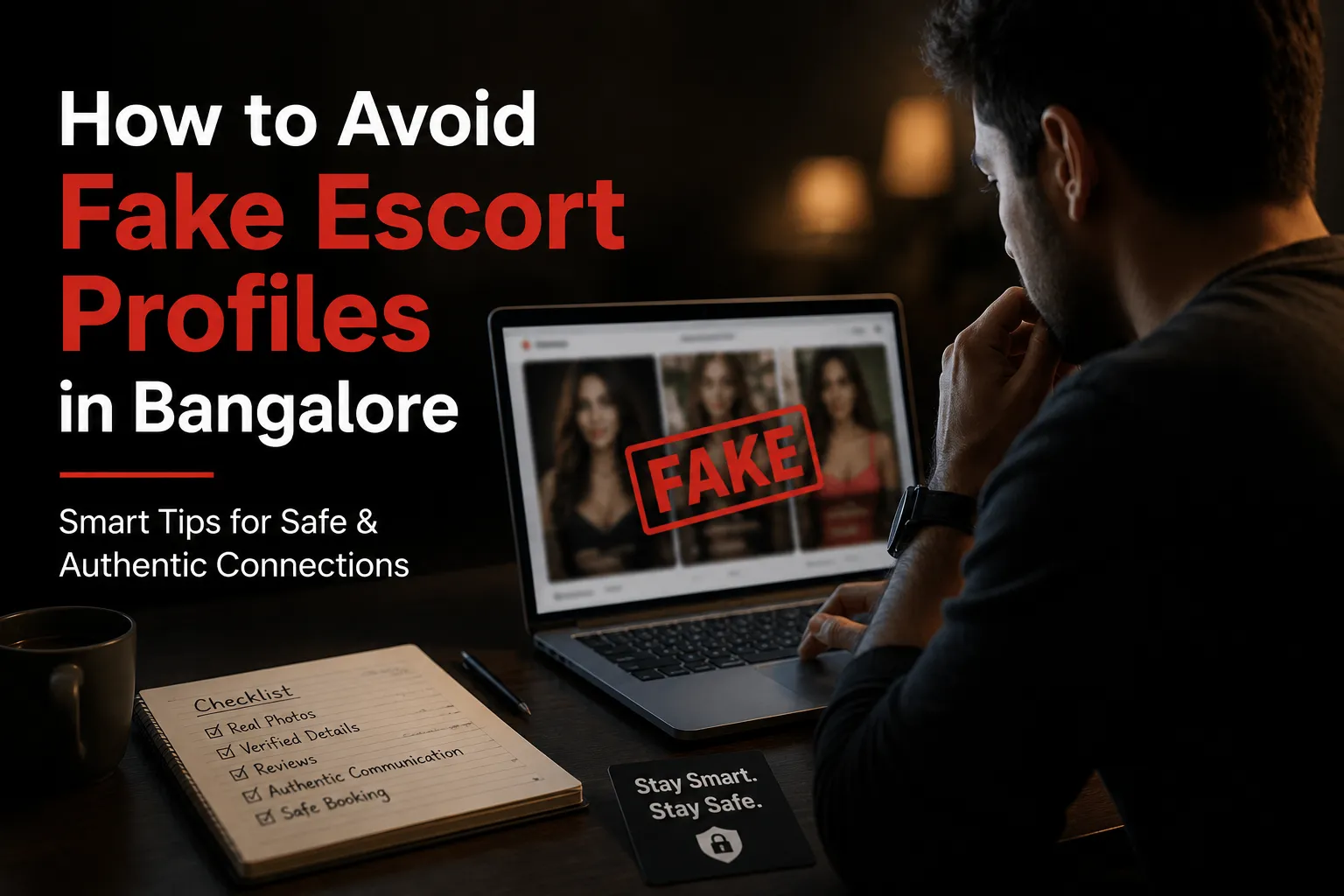
A convincing profile can be assembled in minutes. A few polished photographs, a new name, a Bangalore location and a confident message may look coherent even when none of those elements belong together. That is why the safest question is not, “Does this profile look real?” It is, “Can I trace where its claims came from, and do they remain consistent when I check them?”
People searching for genuine call girls in Bangalore are usually trying to avoid copied photographs, invented biographies, outdated listings or last-minute substitutions. No badge, selfie or reverse-image result can settle that question alone. A stronger decision comes from comparing several independent signals while respecting the privacy of the adult whose profile you are viewing.
This guide presents a practical way to do that. It concentrates on profile authenticity rather than making broad claims about an entire service. You will learn how to examine an image set, search for earlier copies, interpret conflicting names and locations, recognise the limits of AI-image detection, ask for reasonable confirmation and know when an unresolved inconsistency should end the enquiry.
The short answer: check provenance, not perfection
Profile provenance means the traceable history behind what you see: where the photographs appear, whether the written details agree, who appears to control the listing and whether the information is still current.
Use four questions:
- Source: Do the images or words appear elsewhere, and in what context?
- Continuity: Do the face, description, location and conversation describe the same adult?
- Control: Can the contact explain or confirm the profile without evasion, pressure or an identity switch?
- Currency: Is the listing being represented as current, or is old material being presented as live availability?
A profile becomes more credible when several answers align. It becomes less credible when each check produces a new name, city, age, contact number or explanation. The goal is not to uncover someone’s private legal identity. It is to determine whether the public listing is being represented honestly enough for an adult, consensual enquiry.
What counts as a fake escort profile?
“Fake” is often used too loosely. A privacy-conscious profile may hide a face, use a stage name or publish professionally edited photographs without being fraudulent. Conversely, an apparently casual selfie can be stolen, altered or attached to an invented biography.
It is more useful to identify the specific type of mismatch.
| Profile problem | What it means | What a reader may notice |
|---|---|---|
| Stolen identity | Another person’s images or details are used without permission | The same face appears under unrelated names or businesses |
| Recycled profile | Old material is presented as if it describes a current listing | Dates, age, contact or city claims conflict across older pages |
| Cross-city clone | One profile is duplicated across many locations with no credible explanation | The same person is described as immediately available in distant cities |
| Synthetic or composited image | A face or scene is generated, face-swapped or heavily reconstructed | Image history is absent and visual details may be inconsistent, though appearance alone is not proof |
| Misleading edit | A genuine photograph is changed so substantially that it no longer represents the person fairly | Features, proportions or backgrounds vary beyond normal lighting and retouching |
| Invented biography | The words are fabricated or copied even if the image is legitimate | The same unusual description appears on unrelated profiles |
| Bait profile | An attractive listing is used to start enquiries but a different person is repeatedly offered | Availability disappears as soon as the selected profile is named |
| Unauthorised syndication | A real profile is copied to another website without the subject’s or publisher’s consent | Several copies exist, but only one appears current or controlled |
These categories matter because the response should fit the evidence. One old duplicate may be an abandoned listing. A photograph on a portfolio site could come from an authorised shoot. A profile on two platforms may reflect legitimate advertising. None of those explanations should be assumed, but neither should a search match automatically become an accusation.
The strongest warning is a contradiction that the contact cannot explain consistently. For example, a profile says the person is based in Indiranagar, an older copy identifies the same image as a model in another country, and the contact immediately changes the selected person when asked about it. That combination carries more weight than any one detail by itself.
Privacy is not the same as deception
Adult companions have legitimate reasons to protect their legal names, home addresses, workplaces and family information. A stage name is not inherently false. A cropped photograph is not automatically stolen. A face may be blurred to reduce unwanted recognition, harassment or unauthorised reuse.
The distinction is whether the privacy measure is disclosed and whether the remaining claims are materially honest. A transparent profile might state that facial details are protected publicly and that limited confirmation is available through the official enquiry process. A deceptive profile presents another person’s face as the advertised person, invents a biography or knowingly uses a listing that cannot be fulfilled.
This distinction protects both sides. It prevents readers from treating privacy as guilt, and it prevents publishers from using “privacy” as a blanket excuse for unrelated images or identity switches.
Do not demand an Aadhaar card, passport, home address, personal social-media account or unmasked workplace details. Those requests create a new privacy and impersonation risk. A responsible authenticity check asks only for enough consistency to assess the public profile.
Start with a profile snapshot before you search
Fake or misleading pages can change after questions are raised. Before running any checks, record the public facts that influenced your decision. This is not an invitation to collect private information. A simple note is enough:
- profile display name;
- profile URL and the website domain;
- date and approximate time viewed;
- stated Bangalore area, if any;
- stated age, languages or general interests;
- number of photographs shown;
- official contact channel linked from the website; and
- any claim that the profile is current, recently updated or available.
Take a screenshot of the public page if you need to compare it later. Store it privately and delete it when it is no longer needed. Do not republish the image, post accusations or use the material to identify relatives.
The snapshot provides a fixed reference. If the name, images or description change during the conversation, you can distinguish a genuine correction from a complete substitution.
The Profile Provenance Map
Instead of awarding points for beauty, price or popularity, map the profile across four evidence zones. Each zone answers a different question, and no zone substitutes for the others.
| Evidence zone | Question | Useful signals | What it cannot prove |
| Image history | Where have these visuals appeared? | Earlier pages, matching crops, stock or portfolio sources, dates | Who currently controls the profile |
| Profile continuity | Do the public details agree with one another? | Stable face, age range, writing, location context and image sequence | Legal identity or future availability |
| Contact continuity | Does the conversation stay attached to the selected profile? | Correct profile reference, clear explanation of discrepancies, no surprise switch | That every business claim is true |
| Publisher custody | Does the website appear to manage the profile responsibly? | Review date, authorised-image statement, correction route, consistent domain contact | That no fraud or error can occur |
Think of the map as a contradiction detector. A green signal in one zone does not erase a red signal in another. A reverse-image search with no results, for instance, does not rescue a conversation in which the contact refuses to name the selected profile and sends three unrelated image sets.
Check 1: review the whole gallery before focusing on a face
A single hero photograph is easy to copy. A coherent gallery is harder to assemble, although it still can be fabricated. Begin by looking at the set as a sequence.
Ask whether the following details remain plausible across the images:
- facial structure, including features that ordinary makeup or angles would not completely change;
- hairline, length and colour, allowing for styling and time;
- visible tattoos, jewellery or other repeat details;
- room, mirror, furniture or photographer backdrop;
- image resolution and compression;
- season, clothing and apparent age range; and
- the balance between professional photographs and casual images.
Normal galleries contain variation. Lighting can change skin tone. Lenses can change perspective. Makeup, hair and retouching can create large visual differences. Do not diagnose manipulation simply because two pictures are not identical.
Look instead for discontinuity: one photo appears to show a completely different face; a tattoo moves sides without a mirror explanation; every image has a different body and background; or the profile contains unrelated watermarks that have been cropped out unevenly.
A mismatch is a reason to investigate, not permission to insult the person shown. Record what is observable: “Images two and four appear to show different facial features,” not “This person is fake.” Precise language keeps the enquiry fair.
Check 2: reverse-search more than one image
Google Lens and similar reputable image-search tools can return visually similar images and websites that contain the same or a related picture. Google’s search-by-image guidance explains the basic process.
Search at least two or three images when possible:
- Start with the full hero image.
- Search a second photograph with a different pose or setting.
- Try a crop around the face or a distinctive background detail.
- Open the source pages rather than judging from thumbnails.
- Compare names, dates, locations, watermarks and page ownership.
Why several images? A copied advertiser may take only the most attractive photograph. A reverse search may recognise one crop but miss another. An altered background can hide a full-image match while a facial crop still connects to an older source.
Interpret results by context:
- Same person, same name, related platform: potentially consistent, but check whether the profiles appear authorised and current.
- Same person, different stage name: not automatically deceptive; stage names can vary. Location, publisher and timeline still need an explanation.
- Same image, unrelated celebrity, influencer or photographer portfolio: strong evidence that the listing image may be misattributed.
- Same gallery across many cities with immediate availability claims: significant continuity problem.
- Stock-photo result: strong reason to question any claim that the image shows the advertised person.
- No result: unresolved, not verified.
Search tools do not index every webpage or private account. New, cropped, filtered or AI-generated images may produce no useful result. Treat “nothing found” as an empty evidence field, not a certificate of authenticity.
Check 3: examine the image’s online history, not just duplicates
A duplicate tells you that the image exists elsewhere. The timeline helps you judge which appearance may be earlier and whether a current claim makes sense.
Google’s “About this image” feature can provide context such as when an image or similar versions may first have been seen by Google and how other sites use it. Google’s official help page describes the information that may be available. Availability varies by image, region and interface, so the absence of a timeline is not suspicious by itself.
When a timeline is visible, ask:
- Does an older page identify a different source?
- Is the earliest visible use a photographer, model portfolio or social account rather than an escort listing?
- Did the image appear years before the profile’s claimed “new” photo session?
- Are later copies using different names but repeating the same biography?
- Does the current website explain that some images are illustrative rather than personal?
Dates require care. The earliest result in a search tool may not be the actual first publication. Pages can be re-indexed, removed or migrated. A new date on a copied page does not establish ownership. Use the timeline to generate a question, not to deliver a final verdict.
Check 4: follow watermarks, crops and backgrounds
Small details can reveal a source chain that facial search misses.
A cropped watermark at the edge may indicate that the image came from another publisher. A hotel logo, studio backdrop or photographer mark can lead to an earlier context. Product labels, signage and architecture may contradict a claimed location, although travel is common and scenery alone cannot establish where someone lives.
Try these searches:
- the exact visible watermark in quotation marks;
- the photographer or studio name;
- a crop of a distinctive dress, wall, chair or mirror;
- the filename if it contains a brand or username; and
- a short, unusual phrase from the image caption.
Do not overread background clues. A photograph taken in Mumbai can legitimately appear on a Bangalore profile if the person travelled or the shoot occurred there. The relevant question is whether the website falsely claims the photo proves a specific Bangalore location or refuses to explain an obvious source conflict.
Check 5: compare the biography with itself
Photographs receive most of the attention, but fabricated profiles often fail in the text.
Read the biography once for meaning and again for consistency. Look for:
- conflicting ages on the profile card and full page;
- a language claim that changes between sections;
- one area named in the title and another in the body;
- a copied name left inside a paragraph;
- pronouns or personal details that shift without explanation;
- an implausible claim of being simultaneously local to many distant cities; and
- a recent-update label attached to obviously stale information.
Then search one or two distinctive sentences in quotation marks. Avoid generic phrases such as “elegant and friendly”; they will produce noise. Choose an unusual sequence of eight to twelve words. If the same paragraph appears on many unrelated profiles, the biography may be templated or copied.
Templates are not proof of fraud. Agencies often standardise layout and edit profiles for tone. The concern is when supposedly personal facts are identical across different people, when an old name remains in the copy or when the words contradict the photographs and conversation.
For readers looking for real call girls Bangalore results, this textual continuity is often more useful than keyword-rich claims. A page repeating “real,” “100% genuine” or “verified” offers marketing language, not provenance.
Check 6: test location claims without turning them into surveillance
Bangalore profiles commonly reference areas such as Indiranagar, Koramangala, Whitefield, HSR Layout or the central business district. Local detail can help a reader understand general feasibility, but naming a neighbourhood does not prove that a profile is controlled by a local person.
Look for reasonable continuity rather than secret local knowledge:
- Does the area remain the same across the profile and conversation?
- Is a citywide or travelling profile described honestly?
- Does the contact suddenly move the selected person from one end of the city to another without acknowledging the change?
- Does the identical profile claim immediate local availability in Bangalore, Delhi, Mumbai and several other cities at once?
- Are location pages generated by swapping city names while leaving contradictory landmarks in the text?
Do not ask for a live home location, residential proof or a photograph outside a private address. Those are invasive requests and can create safety risks. Approximate location continuity is enough for a profile check.
Travel and schedule changes happen. A change becomes concerning when the explanation keeps shifting or the location claim was clearly used to create false urgency.
Check 7: treat “recently updated” as a claim to verify
A timestamp can be changed automatically. A profile can show today’s date while the gallery and biography have not been reviewed for years.
Signs of a genuinely maintained profile may include:
- a clear “last reviewed” date rather than a constantly changing page date;
- a material update note, such as a new authorised gallery or changed enquiry status;
- working links and consistent contact details;
- a current profile identifier that the contact recognises; and
- a process for correcting or removing outdated material.
Staleness is not always deception. A dormant profile may remain online by mistake, or an adult may take a break. The misleading act occurs when old content is knowingly presented as a current, specifically available person.
Ask a narrow question: “Is profile CB-17 current, and were the public details reviewed recently?” A useful answer identifies the profile and explains its status. A weak answer ignores the identifier, sends a new gallery and asks you to choose again.
Check 8: do not rely on visual “AI tells”
Generated and face-swapped images have made authenticity checks harder. Lists of supposed giveaways—odd fingers, strange teeth, mismatched earrings or blurred backgrounds—can occasionally reveal a problem, but they are unreliable as a standalone method. Generators improve, ordinary cameras make artefacts, and aggressive beauty filters can distort genuine photographs.
Use visual anomalies only as prompts for additional checks:
- Search multiple crops and gallery images.
- Compare recurring features across the set.
- Look for a plausible source history.
- Ask whether the publisher can describe its image-authorisation process.
- Check for provenance information where available.
- Keep the outcome “unresolved” if evidence remains incomplete.
Avoid uploading sensitive images to unknown “AI detector” websites. Their accuracy, data retention and training-use policies may be unclear. A detector score is not identity verification, and sharing another person’s photograph can create a privacy problem of its own.
The same caution applies to editing. Skin retouching, colour correction and background cleanup do not automatically make a profile fake. The issue is material misrepresentation: whether the final image is being used to depict someone it does not fairly represent.
Check 9: use Content Credentials as supporting evidence
Some digital images now carry Content Credentials, a provenance record that may show where content originated, how it was edited and whether particular tools were involved. The C2PA specification describes cryptographically verifiable provenance and tamper-evident records; the consumer still uses the signer and other signals to judge the assertions. The current C2PA specification explains that trust decision.
If a credential is present, review:
- who or what signed the record;
- whether the credential validates;
- the creation and editing history disclosed;
- whether generative tools or composite ingredients are identified; and
- whether the record appears attached to the same image you are viewing.
Content Credentials can strengthen a source chain. They do not prove that the person in an image consented to an escort listing, that a biography is accurate or that the contact controls the depicted person. A valid record about how a photo was edited is different from identity verification.
The absence of credentials is also not proof of deception. Adoption is optional, platforms can strip metadata and older cameras or workflows may not support it. Use provenance data when it exists; do not punish a profile simply because it does not.
Check 10: verify control with a small, respectful question set
Once the public checks are complete, the conversation should stay tied to the selected profile. Use the profile name or identifier and ask only what is needed.
A concise message could be:
I’m enquiring about profile CB-17. Before discussing plans, can you confirm that this is the current profile, that the displayed images are authorised for this listing, and whether any image is illustrative or privacy-protected? I found an older copy under another name and would appreciate a clear explanation.
The value is not in a particular phrase. It is in whether the reply addresses the exact profile and discrepancy.
Credible responses may explain that:
- a stage name changed;
- an old authorised listing remains online;
- another site copied the image without permission;
- selected images are representative and are labelled that way; or
- the profile is no longer current and should not be booked.
An explanation is not automatically true. Compare it with the evidence you already found. If the contact says an old copy was unauthorised, is there a stable current page and a way to report the clone? If the profile uses illustrative images, was that disclosed before you asked?
Warning responses include:
- refusing to identify the selected profile;
- sending a different gallery without acknowledging the change;
- insulting or threatening you for asking a normal question;
- claiming that “verified” is the only explanation needed;
- demanding private documents before answering a public-profile question; or
- changing the story each time the duplicate is mentioned.
Check 11: keep live confirmation limited and voluntary
A short voice or video confirmation can sometimes resolve whether a contact is linked to the advertised adult. It also carries privacy and recording risks, so it should never be treated as an entitlement.
If a service or independent adult offers confirmation, keep it:
- voluntary for everyone;
- arranged through the official contact channel;
- brief and non-explicit;
- free from demands to display identity documents or private surroundings;
- clear about whether recording is prohibited; and
- limited to resolving the profile question.
A live call is not perfect evidence. Prerecorded clips can be replayed. Face-swapping can affect video. A coordinator may manage communication legitimately. Refusing a video call is not proof that a profile is false, especially when privacy policy rules it out.
What matters is the total pattern. A privacy-based refusal accompanied by a coherent gallery, traceable source, stable profile and clear explanation differs from a refusal combined with copied celebrity photographs, changing names and an immediate substitution.
Never pressure an adult to provide intimate proof, reveal a legal name or show a private location. Authenticity and consent have to coexist.
Check 12: set a substitution boundary before the enquiry progresses
A bait profile works because the reader becomes attached to the original image and then accepts a replacement after investing time, attention or money. Break that pattern early.
State that your enquiry concerns one profile and that a different person requires a new decision. If the selected adult is unavailable, pause. Review the replacement from the beginning rather than treating it as a continuation of the first profile.
An ordinary schedule change can be handled transparently: the contact says the selected person is unavailable, does not pretend otherwise and gives you the option to stop. A deceptive switch hides the change, sends unrelated photographs or claims that the person shown is “basically the same.”
Use a simple boundary:
If this profile is not current or available, please tell me directly. I will not proceed with an unreviewed replacement.
This article does not attempt to cover every service, payment or meeting risk. Profile authenticity is one part of a broader decision. A consistent profile should not be treated as a guarantee about anything beyond the evidence checked.
How to read conflicting results
The most common mistake is forcing every profile into “real” or “fake” too early. Use three outcomes instead.
Consistent
The images have a plausible source history; the gallery and biography align; location claims are coherent; the contact recognises the profile; any duplicate or stage-name difference has a credible explanation; and no material contradiction remains.
“Consistent” means the evidence supports the public representation. It is not a guarantee of identity, availability, safety or service quality.
Unresolved
Searches return little information; the profile is privacy-protected; there is no direct contradiction; and the contact gives a limited but plausible response.
An unresolved profile is not guilty or verified. Decide whether you have enough evidence for your risk tolerance. It is reasonable to stop without accusing anyone.
Contradictory
The same photos belong to an unrelated public figure or stock source; the biography is copied across unrelated identities; the profile changes during the conversation; or the contact cannot keep the name, city and gallery consistent.
A material contradiction should outweigh attractive photographs, discounts, testimonials and urgency. Stop the enquiry. You do not owe a stranger a debate.
A Profile Consistency Grid you can use
Complete this grid privately. Do not send it as an interrogation script.
| Field | Consistent | Unresolved | Contradictory |
| Gallery | Same adult plausibly shown across images | Too few or protected images to assess | Clearly unrelated people or altered source marks |
| Reverse-image search | Related, explainable uses | No useful result | Unrelated person, stock source or conflicting identity |
| Image history | Timeline fits the explanation | Timeline unavailable | Older source disproves the current claim |
| Biography | Stable name, age range and personal details | Generic but not conflicting | Copied name, age or city conflicts |
| Bangalore context | General area and travel status align | Little local detail | Simultaneous or shifting city claims |
| Contact response | Direct, calm and profile-specific | Limited but plausible | Evasive, threatening or repeatedly changing |
| Profile status | Current/review status explained | Status not clearly documented | Stale listing represented as immediately current |
| Confirmation | Proportionate option or clear privacy policy | Not available | Different person presented as the selected profile |
Two principles keep the grid honest:
- A blank is not a green tick. Missing evidence remains unresolved.
- One decisive contradiction can end the enquiry. You do not need to average a stolen celebrity photograph against five cosmetic positives.
Do not turn the grid into a public rating of a person. It is a private decision aid for assessing a listing.
Three hypothetical examples
The following scenarios are invented to show how the method works. They do not describe a real person, website or customer.
Example 1: the older profile with a different stage name
Arun views a profile called Mira. Reverse search finds two photographs on an older Bangalore directory under the name Naina. The face, general description and city are similar, but the older page uses a disconnected number.
That is a discrepancy, not yet proof of fraud. Arun records the URLs and asks whether the stage name changed. The current contact identifies the exact profile, explains that the older listing is no longer controlled and points to a current review date. The remaining gallery is coherent.
Outcome: potentially consistent, provided the explanation aligns with the dates and no other conflict appears. The existence of two stage names alone does not reveal the adult’s legal identity and does not require an accusation.
Example 2: the instant multi-city clone
Dev finds the same six photographs on pages claiming current availability in Bangalore, Hyderabad, Delhi and Mumbai. Each page describes the person as permanently local, and the biographies contain different ages. When Dev names the Bangalore profile, the contact sends another gallery and says the original person is “busy today.”
Outcome: contradictory. The cross-city duplication, age conflicts and immediate identity switch form a coherent warning pattern. Dev ends the enquiry without trying to determine which page, if any, is original.
Example 3: a protected profile with no search match
Sameer sees a profile with a blurred face and two professionally lit photographs. Image search returns nothing. The page clearly states that public images are privacy-protected, provides a stable profile identifier and explains the limited confirmation process. The contact answers only profile-relevant questions and does not request invasive information.
Outcome: unresolved but not inherently deceptive. The lack of a public face reduces available evidence, while the disclosure and continuity add context. Sameer can proceed cautiously or stop. Neither choice requires claiming the profile is fake.
Red flags that deserve more weight than appearance
Some signals are not subtle. Stop when the profile or contact presents any of the following:
- a photograph traced to an unrelated celebrity, influencer, stock library or photographer’s subject;
- different adults represented as the same selected profile;
- a child, anyone described as under 18, or youth-coded language that creates age ambiguity;
- signs of coercion, control, exploitation or inability to consent;
- threats, blackmail or demands tied to private information;
- a request to ignore an obvious identity mismatch;
- a claim that no authenticity questions are allowed;
- repeated replacement galleries with no clear profile identifier; or
- retaliation after a reasonable request to correct or remove stolen material.
Do not continue to “test” a profile that may involve a minor or coercion. Preserve only what is necessary to report the concern through an appropriate official channel. Do not download, share or circulate exploitative imagery.
Signals that look reassuring but prove very little
“100% genuine” language
Anyone can type it. The phrase has value only when the publisher defines its process: image authorisation, profile review, age assurance, update frequency and correction handling.
A verified badge
A badge may represent an internal review, a phone check, a payment or nothing documented at all. Look for a public explanation of what the badge covers and when it was last reviewed.
A high search position
Search ranking measures relevance and other ranking signals; it does not certify that every image belongs to the person described. Sponsored placement is advertising, not profile verification.
A selfie
Selfies can be original, copied, filtered or generated. Casual styling changes how an image feels, not what it proves.
Professional photography
A professional shoot may support a coherent portfolio, but the same image can be stolen from a photographer or another model. Search the image and examine authorisation.
Many reviews
Reviews can add context, but they may be fabricated, incentivised or attached to a general service rather than a particular profile. They do not replace image and identity continuity.
A video clip
A clip can be old, borrowed, pre-recorded or altered. Check whether it is linked to the current profile and conversation.
No reverse-search result
This only means the tool did not find an indexed match. It does not mean the image is original, recent or authorised.
How verified escorts in Bangalore should be presented
The phrase verified escorts Bangalore should describe a documented publishing process, not a decorative label. A responsible profile system should answer these questions internally and, where privacy allows, explain the answers publicly.
Are the images authorised?
The publisher should record who supplied each image, whether the depicted adult authorised its use, which pages may display it and when that permission should be reviewed. Consent to one platform should not be treated as unlimited consent for syndication.
Is adulthood confirmed?
The publisher should have an adult-only assurance process that does not expose identity documents to the public. The article should not claim a specific method until Classy Bangalore Escorts confirms its real procedure and data protections.
Is the profile tied to a stable identifier?
Names can change for privacy. A non-public or public profile ID allows updates, enquiries and corrections to refer to the same record without revealing a legal identity.
When was the information reviewed?
A meaningful review date should reflect an actual check, not a timestamp that changes whenever the page loads. Expired or paused profiles should be marked or removed rather than represented as current.
How are edits logged?
If photographs, names, areas or descriptions change, an internal version history helps the publisher distinguish a legitimate update from an account takeover or unauthorised substitution.
Can a depicted person request correction or removal?
There should be a clear impersonation and image-rights contact route. A report should be acknowledged, assessed and acted on without demanding unnecessary public disclosure.
Are representative images labelled?
If a brand chooses to use an illustrative or privacy-protected visual, it should not present that visual as a literal photograph of a named person. Clear labelling prevents a privacy measure from becoming deception.
For a reader, absolute statements such as “every profile is guaranteed genuine” carry little weight. A more useful publisher statement is specific and auditable: what is checked, what remains private, when the profile was reviewed and how an error can be reported.
What to do when you find a likely stolen or cloned profile
You do not need to investigate the person behind the listing. Limit your action to protecting yourself and giving the relevant platform enough information to review the page.
- Stop the enquiry. Do not continue simply to collect more evidence.
- Save minimal public evidence. Record the URL, display name, date, public contact and the source that appears to conflict.
- Use the website’s reporting route. Describe the exact mismatch without publishing personal details.
- Report impersonation to the source platform. If a social network, portfolio site or image host appears to contain the original, use its official impersonation or copyright process where appropriate.
- Do not contact relatives or employers. A stage name or stolen image does not justify exposing the depicted person.
- Do not threaten the listing operator. Quietly disengage and use formal reporting channels.
- Escalate cybercrime concerns appropriately. India’s National Cyber Crime Reporting Portal includes facilities to check suspect mobile numbers, email addresses, account numbers, URLs and websites, and to report suspect identifiers. See the official National Cyber Crime Reporting Portal.
If money has already been lost or threats have begun, preserve messages and transaction records and use official reporting and financial-provider channels promptly. This guide is informational and is not legal advice.
A five-minute profile check
When time is limited, use this sequence before a detailed enquiry:
- Save the profile URL, display name or ID and view date.
- Compare the face and recurring details across the full gallery.
- Reverse-search at least two images and one useful crop.
- Check where the earliest visible or most credible source appears.
- Search one distinctive biography sentence in quotation marks.
- Compare age range, city, area and profile status across the page.
- Ask whether the images are authorised and the profile is current.
- Treat no result as unresolved, not verified.
- Refuse an unreviewed replacement.
- Stop for stolen identities, minors, coercion, threats or material contradictions.
This checklist cannot prove that a stranger is trustworthy. It can help you avoid making a decision from one attractive image or one marketing label.
Frequently asked questions
How can I tell whether an escort profile photo is genuine?
Check several photographs, not just the main image. Reverse-search full images and useful crops, open the matching pages, compare dates and names, and assess whether the gallery and biography remain consistent. Then ask the official contact a narrow question about any discrepancy. No single search result proves identity.
Does a reverse-image search prove that a profile is fake?
No. A match can show that an image appears elsewhere, but the same adult may use more than one platform or stage name. The image may also have been copied from the current profile. Investigate the source, timeline, location and explanation. A match to an unrelated celebrity or stock source is much stronger contradictory evidence.
Why do fake escort profiles in Bangalore sometimes use selfies?
A selfie feels informal, which can make it seem authentic, but it can be copied or altered like any other image. Judge its source history and consistency with the rest of the profile. Image style is not identity evidence.
Are hidden-face profiles always fake?
No. An adult may protect their face for privacy and safety. Look for transparent disclosure, a stable profile identifier, coherent details and a proportionate confirmation policy. Do not demand government identity documents, home information or an explicit video.
Can AI detectors identify every generated profile image?
No. Detector accuracy varies, and ordinary editing or compression can affect results. Visual anomalies and detector scores should trigger more research, not a public accusation. Prefer source history, gallery continuity, publisher custody and a profile-specific explanation.
What does “verified” mean on an escort profile?
It depends on the publisher. A useful label should define what was checked—such as adulthood, image authorisation, current profile status or contact control—and when the review occurred. If the site does not explain the badge, treat it as an unverified marketing claim.
What should I do if the person offered is different from the profile?
Pause and treat the replacement as a new profile. Do not let prior time or commitment pressure you to accept an unreviewed identity. If the change was hidden, repeated or accompanied by threats, end the enquiry and preserve only the information needed for an appropriate report.
Make consistency the standard
The safest way to evaluate genuine call girls in Bangalore is not to search for a flawless photograph. It is to look for a traceable, current and internally consistent profile that survives reasonable questions.
Search image history. Compare the full gallery. Read the biography for contradictions. Check how the listing handles privacy, stage names and updates. Ask the official contact to address the exact profile rather than accepting a stream of replacements. Most importantly, allow a material contradiction to end the process.
For a discreet adult enquiry with Classy Bangalore Escorts, begin with the current profile page and its official contact channel. Refer to the profile by name or identifier, ask whether its images are authorised and its details are current, and keep every request respectful of consent and privacy. If the answers do not remain consistent, do not proceed.







Leave a Reply