
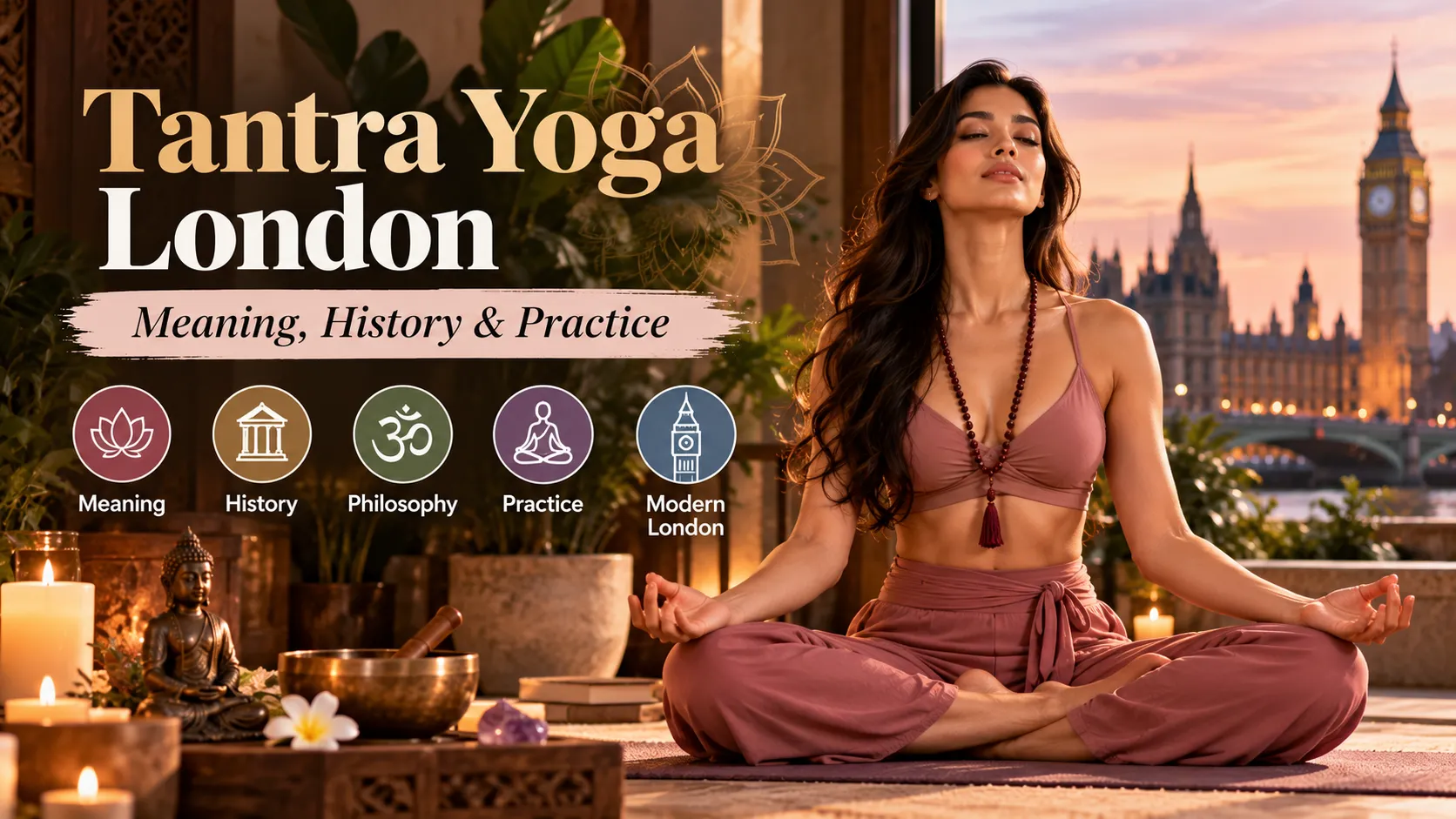
Tantra Yoga is one of the most misunderstood subjects in modern yoga and wellness.
For some people, the term immediately suggests meditation, breathwork and subtle-energy practices. Others associate it with ancient Indian spiritual traditions. Some encounter it through modern yoga classes, while others discover the word Tantra through contemporary wellness, relationships or body-awareness practices.
All of these associations help explain why defining Tantra Yoga in a single sentence is difficult.
Tantra is not one standardized exercise system, one philosophy or one modern wellness practice. Historically, the term developed across a broad range of South Asian traditions, texts and methods. Wikipedia’s overview of Tantra describes traditions developing on the Indian subcontinent around the middle of the first millennium CE, particularly in Shaiva and Shakta contexts before influencing Buddhist and other religious traditions. It also notes the importance of practices such as mantra, ritual and yoga.
Modern Tantra Yoga draws selectively from this much wider heritage.
Depending on the teacher or school, it may include:
- physical yoga postures;
- conscious breathing;
- meditation;
- mantra;
- concentration;
- visualization;
- mudra;
- subtle-body concepts;
- ritual;
- philosophical study;
- sensory awareness;
- mindful movement;
- contemplative self-observation.
The central idea is not simply to perform increasingly difficult yoga poses.
A tantric approach often asks you to become more aware of experience itself.
How are you breathing?
Where is your attention?
How does the body respond to movement?
What happens when you stop trying to achieve something?
How do sensation, thought and awareness interact?
These questions help explain why Tantra Yoga continues to attract people looking for something beyond exercise alone.
This comprehensive guide explores the history, meaning, philosophy, major practices, misconceptions, safety considerations and modern relevance of Tantra Yoga.
It also explains how Tantra Yoga differs from conventional yoga, Hatha Yoga, Kundalini Yoga and neo-Tantra, and how someone in London can evaluate modern tantra-related wellness services without confusing yoga, traditional Tantra and professional bodywork.
What Is Tantra Yoga?
Tantra Yoga is a broad term for yogic practices shaped by tantric philosophy, methods or contemplative frameworks.
There is no single universal Tantra Yoga sequence.
There is no internationally standardized list of Tantra Yoga poses.
There is no one governing organization deciding what every Tantra Yoga teacher must practise.
This is important because modern yoga culture often expects each label to describe a recognizable physical style.
Vinyasa may suggest flowing movement.
Yin Yoga may suggest longer-held postures.
Restorative Yoga often suggests supported relaxation.
Tantra Yoga is less straightforward because its identity comes as much from philosophy and method as from the physical movements being performed.
A Tantra Yoga session might contain familiar postures, yet the emphasis can be quite different.
Instead of asking:
How far can I stretch?
the practitioner may ask:
What am I experiencing while I stretch?
Instead of asking:
Can I master this posture?
the question may become:
What does effort feel like in my body and mind?
Instead of racing toward the next position, tantric-inspired practice may emphasize the transition itself.
Breathing becomes part of the practice.
Sensation becomes part of the practice.
Attention becomes part of the practice.
Stillness becomes part of the practice.
In this sense, Tantra Yoga can be understood as an approach to integrating body, breath, mind and awareness.
Tantra Yoga in Simple Terms
For a beginner, the simplest useful definition is:
Tantra Yoga is a broad approach to yoga that uses practices such as posture, breath, meditation, mantra, visualization and focused awareness to explore the relationship between body, mind and consciousness.
That definition is deliberately broad.
Different tantric traditions understand consciousness, energy and liberation differently.
Modern secular teachers may remove most religious language.
Traditional teachers may retain ritual, mantra, scripture and deity-based practices.
A modern yoga studio may incorporate only a small number of tantric ideas.
Therefore, whenever you see the phrase Tantra Yoga, ask what the teacher or organization actually means by it.
Why Is Tantra Yoga So Often Misunderstood?
Few spiritual traditions have been simplified as dramatically as Tantra.
In contemporary Western popular culture, Tantra is frequently associated almost exclusively with sexuality.
Historically, the landscape is much larger.
Wikipedia’s Tantra overview describes traditions involving systems of practice, initiation, ritual, mantra and yoga, while also distinguishing the much narrower place of sexual practices within certain tantric contexts. It notes that Western interpretations have often disproportionately equated Tantra with sex, despite such practices historically being restricted rather than defining Tantra as a whole.
That distinction is essential.
Tantra can involve:
- ritual;
- philosophy;
- meditation;
- sacred sound;
- visualization;
- yoga;
- symbolic systems;
- devotional practices;
- subtle-body models;
- initiation;
- contemplative discipline.
Reducing all of this to one sensational element gives beginners an inaccurate picture.
Modern marketing has intensified the problem.
Today, the word Tantra may appear in descriptions of:
- yoga;
- meditation;
- retreats;
- relationship workshops;
- breathwork;
- massage;
- body-awareness programmes;
- personal-development events;
- spiritual courses.
These services are not automatically equivalent.
A Tantra Yoga class is not automatically a massage treatment.
A meditation workshop is not automatically neo-Tantra.
Traditional Tantra is not synonymous with a modern wellness studio.
Understanding those distinctions protects both historical accuracy and consumer clarity.
Where Did Tantra Come From?
The history of Tantra is complex.
The Sanskrit word tantra has carried different meanings across historical periods.
Wikipedia notes associations with ideas such as a loom, framework, system, doctrine, method or technique. The word therefore did not originally refer exclusively to the category of practices modern Western audiences often imagine when hearing “Tantra.”
Clearly identifiable tantric religious traditions developed later.
Tantra became important in multiple Indian religious environments, including Shaivism, Shaktism and Buddhism, with later influence extending into other traditions.
Rather than imagining one founder creating “Tantra” on a particular date, it is more accurate to imagine a long process of development involving different communities, texts and practices.
This matters for Tantra Yoga because modern websites sometimes present oversimplified claims such as:
“Tantra Yoga is one 5,000-year-old system.”
That type of statement hides considerable historical complexity.
Ancient India certainly possessed yogic, ritual and contemplative traditions long before the period when clearly recognizable tantric systems became prominent.
But Tantra itself developed historically through multiple stages.
A trustworthy modern guide should preserve that complexity rather than manufacture a neat origin story.
What Does the Word Tantra Mean?
The term has a wide semantic history.
Wikipedia discusses the Sanskrit association with weaving, including meanings connected to loom, framework, system, doctrine and method.
The metaphor of weaving is particularly useful for modern beginners.
You can imagine Tantra as weaving multiple dimensions of practice together:
body and mind;
breath and attention;
movement and stillness;
inner experience and outer life;
philosophy and practice.
However, this is best treated as an explanatory metaphor rather than a complete scholarly definition.
Historically, the word has been used in multiple ways.
That is another reason why there is no single definition that captures every form of Tantra.
The Historical Relationship Between Tantra and Yoga
Tantra and yoga are connected, but they are not identical.
Yoga traditions existed in India before the rise of clearly identifiable tantric systems.
Over time, however, tantric traditions incorporated yogic techniques and helped shape practices that later became influential within Hatha Yoga and other systems.
Wikipedia’s overview specifically lists yoga alongside mantra and meditation among tantric practices.
This historical interaction helps explain why modern Tantra Yoga may contain familiar yogic elements.
These can include:
- seated meditation;
- controlled breathing;
- bodily postures;
- concentration;
- subtle-body visualization;
- mantra;
- energy-related concepts.
The important point is that yoga should not be treated as a modern fitness category that Tantra suddenly borrowed.
Yoga itself has a long and diverse history.
Similarly, Tantra cannot be reduced to a single branch of physical yoga.
The traditions interacted over centuries.
The Core Philosophy of Tantra Yoga
There is no single philosophical statement accepted by every tantric school.
Nevertheless, several themes help modern beginners understand why Tantra Yoga often feels different from purely exercise-oriented yoga.
1. Experience Can Become Practice
Tantric approaches frequently use aspects of ordinary human experience as material for awareness.
Breathing can become practice.
Sound can become practice.
Movement can become practice.
Sensation can become practice.
Attention itself can become practice.
You do not necessarily need to escape everyday experience in order to examine consciousness.
2. The Body Can Have Spiritual Importance
Certain traditions influenced by Tantra gave the body an important role within spiritual practice.
That does not mean every bodily feeling is sacred or supernatural.
It means embodiment can be part of the path rather than merely something to ignore.
This principle has substantial influence on modern interpretations of Tantra Yoga.
Instead of treating the body as a machine that must become more flexible, the practitioner learns to observe it.
3. Awareness Matters More Than Performance
Modern yoga culture can sometimes become achievement-oriented.
People compare flexibility.
They compare difficult poses.
They count classes.
They photograph advanced postures.
Tantra Yoga can offer a different orientation.
A very simple posture practised with deep attention may be more valuable than an advanced posture performed without awareness.
4. Integration Is Important
Many modern interpretations of tantric philosophy emphasize integration rather than unnecessary division.
Movement and meditation do not have to exist separately.
The body and mind are not experienced as completely unrelated.
Stillness and activity can both become opportunities for awareness.
5. Transformation Begins With Observation
Before changing a habit, reaction or pattern, you usually need to notice it.
Tantra Yoga therefore often emphasizes observation.
Where does the body tense?
When does breathing become shallow?
What happens when something becomes uncomfortable?
How quickly does the mind become distracted?
These observations create a foundation for more conscious action.
The Body in Tantra Yoga
The role of the body deserves special attention.
Many beginners arrive at yoga because of physical goals:
better flexibility;
improved mobility;
more comfortable movement;
relaxation;
general wellbeing.
Tantra Yoga can include those goals, but it adds another layer.
The body becomes something to experience consciously.
Imagine performing a simple standing posture.
You could focus only on external alignment.
Or you could simultaneously notice:
the pressure beneath your feet;
the position of your pelvis;
the temperature of your hands;
the rhythm of breathing;
the muscles working to keep you upright;
the thoughts appearing while you remain still.
The posture has not changed dramatically.
Your quality of attention has.
This distinction is one of the easiest ways to understand tantric-inspired yoga.
Awareness as a Practice
Awareness sounds simple.
Practising it consistently is more difficult.
Sit quietly for one minute and notice how quickly the mind begins planning, remembering, evaluating and wandering.
Tantra Yoga does not necessarily require those thoughts to disappear.
Instead, you become aware of them.
This can create a subtle shift.
Rather than automatically following every thought, you recognize that thinking is occurring.
Rather than immediately reacting to every sensation, you observe it.
That does not mean becoming passive.
It means inserting awareness between experience and reaction.
Understanding Energy in Tantra Yoga
The word energy appears frequently in Tantra Yoga.
It needs careful explanation.
In traditional contexts, energy-related concepts belong to particular spiritual, philosophical and subtle-body systems.
In modern wellness culture, people may use the word energy much more casually.
They may mean:
vitality;
mood;
physical sensation;
emotional intensity;
alertness;
calmness;
attention.
These meanings should not be confused.
When someone says, “I felt energy moving,” they may be describing a genuine subjective sensation.
That does not automatically establish a biomedical mechanism.
A responsible Tantra Yoga teacher distinguishes traditional language, subjective experience and scientific evidence.
Shiva and Shakti in Tantric Thought
Some Hindu tantric traditions give particular importance to Shiva and Shakti.
Interpretations differ significantly between schools.
In simplified philosophical language:
Shiva may represent consciousness, awareness or stillness.
Shakti may represent dynamic power, creativity or manifestation.
Modern wellness writing often calls these “masculine” and “feminine” energies.
That shorthand should be used cautiously.
Traditional philosophical concepts are much broader than biological sex or conventional gender roles.
For a Tantra Yoga beginner, the useful idea is complementarity.
Awareness and movement can coexist.
Stillness and activity can coexist.
Observation and expression can coexist.
Chakras in Tantra Yoga
Chakras are among the best-known concepts associated with modern yoga.
They are also frequently oversimplified.
The familiar seven-chakra diagram seen throughout modern wellness culture should not be assumed to represent every historical tantric system.
Different traditions described subtle-body structures differently.
In broad terms, chakras can be understood as centres within traditional subtle-body frameworks.
Contemporary practitioners often associate them with different psychological, symbolic or energetic qualities.
It is important not to present chakras as physical organs recognized by conventional anatomy.
They belong to traditional contemplative models.
Someone may find those models meaningful without confusing spiritual symbolism with medical science.
Nadis and the Subtle Body
Nadis are traditionally described as channels within subtle-body systems.
They should not simply be equated with nerves, blood vessels or other anatomical structures.
Certain yogic and tantric traditions describe vital processes through these channels.
Modern Tantra Yoga sometimes uses nadi concepts during:
- breathwork;
- visualization;
- meditation;
- subtle-body contemplation.
Again, the most responsible approach is to understand the concept in its historical and philosophical context.
Kundalini and Tantra Yoga
Kundalini has become one of the most recognizable concepts in modern spirituality.
In certain tantric and yogic traditions, kundalini is associated with latent transformative power.
Popular diagrams often represent this potential as resting near the base of the spine and rising through subtle centres.
This imagery has become extremely influential.
However, beginners should be cautious about treating dramatic “kundalini awakening” as the required goal of Tantra Yoga.
You do not need:
extreme breathing;
physical strain;
sleep deprivation;
forced meditation;
uncomfortable breath retention;
or dramatic emotional experiences
to prove that you are progressing.
A grounded practice values stability.
If something feels overwhelming, reduce intensity.
Mantra in Tantra Yoga
Mantra occupies an important place in numerous tantric traditions.
Wikipedia highlights the centrality of mantra strongly enough to note historical designations connected with a “path” or “vehicle” of mantra in Hindu and Buddhist tantric contexts.
A mantra may consist of:
a syllable;
a word;
a phrase;
a sacred formula.
Its purpose varies by tradition.
Some mantras are recited aloud.
Others are repeated internally.
Certain traditional mantras have lineage-specific contexts.
Modern yoga classes sometimes use accessible chants without extensive initiation.
The important point is that mantra should not simply be described as a positive affirmation.
Historically, it can have a much deeper religious and ritual function.
Meditation in Tantra Yoga
Meditation can take many forms.
A Tantra Yoga practitioner might focus on:
breathing;
a mantra;
a visual symbol;
bodily sensation;
inner imagery;
sound;
conscious awareness;
a traditional deity;
a subtle-body model.
For beginners, the simplest options are often the most useful.
Start by noticing the breath.
Then notice bodily sensation.
Then notice how frequently your attention wanders.
You do not need to empty the mind.
You need to recognize what it is doing.
Visualization in Tantra Yoga
Visualization is important within several contemplative traditions.
The practitioner may imagine:
light;
colour;
a geometric form;
an internal pathway;
a symbolic centre;
a traditional sacred figure.
Modern beginners can use very simple visualization without making exaggerated claims.
For example:
sit comfortably;
breathe naturally;
imagine a gentle point of light;
hold the image loosely;
when your attention wanders, return to it.
The benefit of the exercise is concentration.
There is no requirement to interpret every image mystically.
Yantra and Mandala
Tantric traditions are also associated with sacred geometric and symbolic structures.
Wikipedia identifies mandalas and yantras among the broader range of tantric practices.
A yantra may serve as a symbolic or contemplative visual form.
The Sri Yantra is probably the best-known example among modern audiences.
Mandalas can have complex ritual, cosmological and meditative functions.
They should not be reduced simply to attractive geometric decorations.
When traditional symbols are used in modern Tantra Yoga, teachers should explain their context respectfully.
Mudra
Mudra is often translated as a symbolic gesture or seal.
Modern yoga students most commonly encounter hand gestures during meditation.
Traditional applications can be more complex.
A simple mudra may help organize attention.
For example, joining fingers in a consistent position can provide a sensory anchor during meditation.
The gesture itself is only part of the practice.
Its meaning and context matter as well.
Ritual in Tantra
Ritual is one of the areas most frequently removed from modern Western interpretations.
Traditional Tantra can involve highly structured ritual systems.
These may include:
mantra;
offerings;
visualization;
symbols;
sacred space;
gestures;
deity-related practices;
initiation.
Wikipedia’s overview includes ritual as a central element in tantric systems.
A modern Tantra Yoga class may contain almost none of this.
That does not necessarily make the class invalid.
It simply makes it modern.
Teachers should ideally be transparent about whether they are presenting:
traditional practice;
traditionally inspired yoga;
modern Tantra;
or a contemporary wellness interpretation.
Is Tantra Yoga Sexual?
Tantra Yoga is not inherently sexual.
This deserves direct emphasis because it is one of the most common search questions.
Some historical tantric traditions included restricted sexual rites.
Those practices did not define the entirety of Tantra.
Wikipedia specifically notes the disproportionate Western tendency to equate Tantra with sex and describes historical sexual practices as limited and restricted within particular contexts.
A modern Tantra Yoga session can be completely non-sexual.
It may involve:
posture;
breathing;
meditation;
mantra;
visualization;
philosophy.
A person can practise Tantra Yoga alone.
A partner is not required.
Traditional Tantra vs Modern Tantra Yoga
These two categories overlap but should not be treated as identical.
Traditional Tantra
Traditional systems may include:
scripture;
ritual;
initiation;
teacher-student transmission;
mantra;
deity practices;
meditation;
philosophical study;
subtle-body practices.
Modern Tantra Yoga
Modern classes may emphasize:
body awareness;
accessible yoga;
breathing;
meditation;
movement;
relaxation;
self-observation.
They may retain some traditional language while simplifying ritual or religious elements.
The distinction is not about declaring one automatically superior.
It is about accuracy.
Tantra Yoga vs Neo-Tantra
Neo-Tantra is another important category.
The term generally describes modern systems inspired in varying degrees by Tantra but shaped substantially by contemporary Western ideas.
Neo-Tantra can emphasize:
embodiment;
relationships;
communication;
personal development;
emotional awareness;
breathing;
conscious touch;
intimacy.
Traditional Tantra generally emerges from very different historical, religious and philosophical contexts.
Modern neo-Tantra can still provide meaningful experiences for participants.
The issue arises when a recently developed practice is marketed as an unchanged ancient method.
Transparency is preferable.
Tantra Yoga vs Conventional Yoga
Someone searching “Tantra Yoga vs yoga” is often really asking how a tantric-style class differs from the mainstream yoga class they already know.
The answer varies.
Modern studio yoga often concentrates heavily on physical posture.
Tantra Yoga may give relatively more attention to:
meditation;
breathing;
mantra;
internal sensation;
philosophy;
visualization;
energy-related concepts.
Consider two people performing the same seated pose.
The conventional class might focus on posture, mobility and alignment.
The Tantra Yoga class may use the posture as a setting for breath observation, mantra or internal awareness.
The external position could look nearly identical.
The internal method differs.
Tantra Yoga vs Hatha Yoga
Modern Hatha Yoga commonly refers to a slower physical yoga class involving postures and breathing.
Historically, Hatha Yoga is much richer than that modern studio definition.
Tantric concepts influenced parts of the environment in which Hatha methods developed.
Therefore, it is misleading to imagine Hatha and Tantra as unrelated systems.
Today, however, a practical difference is often:
Hatha Yoga: predominantly physical postures and breath with varying degrees of meditation.
Tantra Yoga: potentially broader use of meditation, mantra, visualization, subtle-body frameworks and tantric philosophy.
Always evaluate the individual teacher rather than relying entirely on the label.
Tantra Yoga vs Kundalini Yoga
Tantra Yoga and Kundalini Yoga overlap in some areas but are not the same thing.
Kundalini is a concept appearing within various tantric and yogic traditions.
Modern Kundalini Yoga may also refer to particular contemporary schools with distinctive teaching systems.
A Tantra Yoga class may mention kundalini without resembling a modern Kundalini class.
A traditional tantric practitioner may work with other methods entirely.
Therefore:
Kundalini is a concept within a wider historical landscape.
Tantra is much broader.
Tantra Yoga vs Vinyasa Yoga
Vinyasa Yoga often emphasizes continuous movement linked with breathing.
Classes may be physically dynamic.
Tantra Yoga does not necessarily depend on continuous flow.
A practitioner might remain still for longer periods.
Transitions may become meditative.
There may be more deliberate pauses.
Mantra or visualization may be integrated.
Neither approach is better.
They serve different preferences.
Tantra Yoga vs Yin Yoga
Yin Yoga usually involves relatively passive postures maintained for longer periods.
Tantra Yoga may also use stillness, but its defining framework is different.
A Tantra Yoga session could include dynamic movement, meditation, breathing, mantra or other techniques.
Yin Yoga describes a more recognizable physical methodology.
Tantra Yoga refers to a broader philosophical and practical orientation.
What Happens During a Tantra Yoga Class?
There is no universal class format.
A modern session might begin with:
- quiet arrival;
- breathing awareness;
- gentle movement;
- standing or seated postures;
- mantra;
- meditation;
- relaxation;
- closing reflection.
Another class might focus heavily on philosophy.
A traditional practice could include ritual.
A modern studio may focus almost entirely on mindful movement.
That variation is why you should read the class description before attending.
A Beginner-Friendly Tantra Yoga Practice
You do not need advanced flexibility.
You do not need special clothing.
You do not need to force unusual experiences.
Try this simple practice.
Step 1: Sit Comfortably
Choose a chair, cushion or mat.
Keep your posture supported.
Close your eyes if comfortable.
Remain still for one minute.
Do not change anything initially.
Where do you feel breathing most clearly?
Nostrils?
Chest?
Abdomen?
Simply observe.
Notice:
feet;
legs;
pelvis;
abdomen;
chest;
hands;
shoulders;
neck;
face.
Do not force relaxation.
Observation comes first.
Raise the arms slowly during an inhale.
Lower them during an exhale.
Repeat several times.
Move at a comfortable speed.
Notice how stillness feels after movement.
This contrast is useful.
Return attention to breathing.
When you notice that attention has wandered, return gently.
Practise for approximately five minutes.
Ask:
What changed?
You may feel calmer.
You may feel restless.
You may notice tension.
You may notice nothing dramatic.
Every outcome provides information.
A 20-Minute Tantra Yoga Routine
A simple home routine can be organized as follows.
Minutes 0–3: Arrival
Sit quietly.
Notice breathing.
Feel contact between your body and the surface supporting you.
Minutes 3–7: Gentle Movement
Use comfortable movements such as:
shoulder circles;
Cat-Cow;
gentle side bends;
slow arm raises.
Minutes 7–11: Simple Postures
Choose a few familiar positions:
Mountain Pose;
Child’s Pose;
comfortable seated posture;
supported Bridge;
gentle forward fold.
Never force range of motion.
Minutes 11–14: Breath Awareness
Sit or lie down.
Observe natural breathing.
If comfortable, allow the exhale to become slightly longer.
Do not strain.
Minutes 14–18: Meditation
Stay with breathing or bodily sensation.
Return whenever attention wanders.
Minutes 18–20: Integration
Rest.
Notice the entire body.
Allow the practice to finish gradually.
A 40-Minute Tantra Yoga Practice
For someone who wants a longer session:
5 minutes — settling and breath awareness
10 minutes — mindful mobility
10 minutes — posture practice
5 minutes — gentle pranayama
7 minutes — meditation
3 minutes — rest and reflection
The structure matters less than the quality of attention.
Tantra Yoga Breathing
Breathing practices can range from simple observation to advanced pranayama.
Beginners do not need complicated methods.
Start with natural breathing.
Observe:
the beginning of inhalation;
the transition into exhalation;
the end of exhalation;
the beginning of the next breath.
Later, experiment with a slightly longer exhale.
Avoid forcing the breath.
Breathwork Safety
Breathwork can affect how you feel quickly.
Stop intensive breathing if you experience:
significant dizziness;
faintness;
strong panic;
uncomfortable chest symptoms;
persistent breathlessness.
Practices involving long breath retention or rapid breathing deserve additional caution.
More intensity is not evidence of better Tantra Yoga.
Tantra Yoga Meditation for Beginners
Try this seven-minute practice.
Minute 1
Become aware of your posture.
Minutes 2–3
Notice breathing.
Minutes 4–5
Notice body sensations.
Minute 6
Allow awareness to include sound.
Minute 7
Notice body, breath and sound together.
Finish slowly.
This simple practice demonstrates an important tantric principle:
awareness can become wider without requiring complicated techniques.
Mindful Movement in Tantra Yoga
Movement creates opportunities for observation.
During a movement, notice:
when muscles begin working;
when you start holding your breath;
whether you rush;
whether you compare yourself;
whether your jaw tightens;
whether effort feels balanced.
This turns exercise into investigation.
Tantra Yoga and Sensory Awareness
Our senses constantly collect information.
Most of it passes unnoticed.
Tantric-inspired practice may use sensory awareness deliberately.
Try listening carefully.
Notice the most distant sound.
Then a closer sound.
Then the sound of breathing.
Then notice silence between sounds.
This is meditation using hearing.
You can practise similar awareness with sight, touch or taste.
Tantra Yoga Beyond the Yoga Mat
Tantra Yoga becomes more interesting when awareness leaves the formal practice space.
You can practise while:
walking;
eating;
travelling;
waiting;
working;
communicating.
For example, during a conversation, notice how quickly you prepare your next response.
During walking, feel the contact between your feet and the ground.
Before checking your phone, notice the impulse to reach for it.
These tiny moments reveal automatic behaviour.
Potential Benefits of Tantra Yoga
Any discussion of benefits should remain realistic.
Tantra Yoga is not a guaranteed medical treatment.
However, practitioners may find that gentle yoga and contemplative practices support:
body awareness;
relaxation;
concentration;
mindful movement;
self-observation;
greater familiarity with breathing;
a less competitive approach to yoga;
personal reflection.
Individual experiences differ.
Tantra Yoga and Stress
Many people explore yoga because they feel mentally overloaded.
A gentle Tantra Yoga session may provide periods of:
quiet;
slower breathing;
reduced external stimulation;
deliberate movement;
focused attention.
Those conditions may feel relaxing.
However, a wellness practice should not replace appropriate professional care for persistent anxiety, trauma, depression or other health concerns.
Tantra Yoga and Flexibility
Tantra Yoga can contain physical postures that gradually improve mobility or flexibility.
But flexibility is not a prerequisite.
Nor is it necessarily the primary objective.
A person who cannot perform an advanced pose can still practise awareness fully.
Tantra Yoga and Concentration
Meditation, visualization and mantra can all exercise sustained attention.
You may quickly discover how frequently the mind wanders.
That discovery is not failure.
Each moment of recognizing distraction is part of concentration practice.
Tantra Yoga and Body Awareness
Body awareness is one of the most practical elements of Tantra Yoga.
People often discover habitual patterns such as:
raised shoulders;
shallow breathing;
jaw tension;
uneven standing;
unnecessary muscular effort.
Awareness does not automatically fix those patterns.
But it makes conscious adjustment possible.
Tantra Yoga and Emotional Awareness
Physical practice can sometimes make emotions more noticeable.
This does not mean every emotion has been “stored” in a particular body part.
Avoid simplistic explanations.
Instead, notice the experience.
If something becomes emotionally overwhelming, stop and seek suitable support when needed.
Yoga teachers should not present themselves as mental-health professionals unless they hold appropriate qualifications.
Is Tantra Yoga Scientifically Proven?
This question needs a nuanced answer.
Yoga, meditation and breathing have each been researched.
However, Tantra Yoga is not one standardized intervention.
Different teachers use different techniques.
Therefore, studies examining meditation generally cannot prove every claim made about tantric meditation.
Research on Hatha Yoga cannot automatically validate every subtle-body theory.
Likewise, traditional chakra concepts should not be presented as established anatomical discoveries.
Three categories should remain distinct:
Traditional teaching
What a particular tradition describes.
Subjective experience
What a practitioner personally feels.
Scientific evidence
What systematic research demonstrates.
Maintaining these distinctions makes wellness content more trustworthy.
Is Tantra Yoga Safe?
Gentle yoga and meditation can be accessible to many adults.
Safety nevertheless depends on:
the individual;
the practice;
the intensity;
the teacher;
health circumstances.
Potentially higher-risk techniques include:
extreme postures;
aggressive stretching;
long breath retention;
rapid breathing;
excessive heat;
prolonged fasting;
sleep deprivation;
psychologically intense exercises.
No responsible teacher should tell you to ignore significant pain or alarming symptoms.
Who Should Seek Additional Guidance?
Additional caution may be appropriate for people:
recovering from surgery;
managing injuries;
pregnant;
managing cardiovascular conditions;
managing respiratory conditions;
prone to fainting;
experiencing acute psychological distress.
Individual circumstances differ.
Qualified medical guidance is appropriate when relevant.
Choosing a Tantra Yoga Teacher
The quality of teaching matters enormously.
Ask the following questions.
What tradition influences your teaching?
The answer should be reasonably clear.
What training have you completed?
Look for transparent information.
What happens during a session?
You should know before attending.
Is physical contact used?
Consent should always be clear.
Are partner exercises included?
Again, ask beforehand.
How intensive is the breathwork?
This matters for safety.
Can I decline an activity?
Yes should always be an acceptable answer.
Tantra Yoga Teacher Red Flags
Exercise caution if a teacher:
guarantees enlightenment;
guarantees kundalini awakening;
claims to cure serious illness;
discourages appropriate medical treatment;
pressures participants;
ignores consent;
refuses to describe the session;
claims questioning is spiritually harmful;
uses fear to create dependence;
encourages dangerous breathing;
insists pain should always be endured.
Healthy teaching allows questions.
Can You Practise Tantra Yoga Alone?
Yes.
Many foundational Tantra Yoga practices are individual.
These include:
breath awareness;
meditation;
body scanning;
gentle yoga;
mantra;
visualization;
mindful movement;
journaling.
You do not need a partner.
More complex traditional practices may require appropriate instruction.
Tantra Yoga for Complete Beginners
If you have never practised yoga before, start simply.
Do not begin with advanced poses.
Do not begin with aggressive breathwork.
Do not chase dramatic kundalini experiences.
Instead:
learn comfortable sitting;
learn gentle movement;
observe your breathing;
practise short meditation;
read about the historical context;
find a transparent teacher if you want deeper study.
A quiet ten-minute practice is perfectly legitimate.
What Should You Wear for Tantra Yoga?
For an ordinary Tantra Yoga class, comfortable yoga clothing is generally sufficient.
Choose clothing that allows unrestricted movement and breathing.
Because different organizations use the Tantra label differently, always check the class description.
Professional providers should explain expectations before the session.
Do You Need Special Equipment?
No.
A simple practice may require nothing more than:
a yoga mat;
a chair or cushion;
comfortable clothing;
a quiet area.
Props such as blocks, blankets and bolsters can improve comfort.
Expensive spiritual objects are not a requirement for awareness.
How Often Should You Practise Tantra Yoga?
Beginners can benefit from consistency.
Try:
10–20 minutes;
three or four times per week.
A short regular practice can be more useful than a long session performed occasionally.
For example:
5 minutes movement;
5 minutes breathing awareness;
5 minutes meditation.
Build gradually.
A Seven-Day Tantra Yoga Introduction
Day 1: Breath
Spend ten minutes observing breathing.
Day 2: Body Awareness
Practise a slow body scan.
Day 3: Movement
Combine breathing with gentle movement.
Day 4: Sound
Practise attentive listening.
Day 5: Meditation
Sit quietly for ten minutes.
Day 6: Integrated Practice
Combine movement, breathing and stillness.
Day 7: Reflection
Ask:
What became easier?
What remained difficult?
What did you notice about your habits?
This creates a practical introduction without unnecessary complexity.
Tantra Yoga in Modern London
London provides access to an enormous variety of yoga, meditation, wellbeing and contemporary Tantra services.
This creates opportunity—and confusion.
A business advertising Tantra may provide:
yoga classes;
meditation;
breathwork;
bodywork;
modern neo-Tantra;
retreats;
relationship workshops;
massage.
The word alone does not tell you what happens during the service.
Someone searching for Tantra Yoga in London should therefore read the provider’s description carefully.
Ask:
Is this actually yoga?
Is the service primarily meditation?
Is it bodywork?
Is it contemporary neo-Tantra?
Is it a traditional spiritual programme?
Clear categorization helps people choose the experience they genuinely want.
Tantra Yoga and Tantric Massage Are Different Practices
This distinction is particularly important for a London audience.
Tantra Yoga is generally an active or contemplative practice performed by the practitioner.
It may involve:
movement;
breathing;
meditation;
mantra;
concentration.
Tantric massage is a professional bodywork category offered by some contemporary wellness providers.
Although modern descriptions of both may use concepts such as:
body awareness;
relaxation;
breathing;
mindfulness;
embodiment,
the services are not interchangeable.
Someone searching for Tantra Yoga may primarily want to learn a practice.
Someone looking for professional massage is usually seeking a service delivered by a practitioner.
Keeping those search intents separate improves clarity for both users and search engines.
From Tantra Yoga to Modern Embodied Wellbeing
Modern wellness culture increasingly uses the term embodiment.
In simple terms, embodiment means paying attention to experience through the body rather than living entirely through abstract thought.
Tantra Yoga naturally intersects with this concept.
During practice you may become aware of:
breathing;
posture;
pressure;
movement;
temperature;
muscular effort;
relaxation.
Modern bodywork can also encourage awareness of physical sensation, although through a different method.
This creates a natural conceptual bridge between educational Tantra Yoga content and a professional wellness brand.
The bridge should remain accurate.
Yoga remains yoga.
Massage remains massage.
Meditation remains meditation.
They can share themes without becoming identical.
Finding a Tantric Massage Parlor in London
Readers who discover Tantra through yoga sometimes become curious about other forms of body-centred wellbeing.
If you are searching for a tantric massage parlor in London, evaluate providers using practical criteria rather than relying only on marketing language.
Look for:
clear service descriptions;
transparent session durations;
published prices where possible;
professional communication;
privacy information;
clean facilities;
clear boundaries;
consent policies;
realistic wellness claims;
easy-to-find contact details.
The phrase tantric massage parlor in London is commonly used as a search term, but individual businesses may describe themselves instead as a massage studio, wellbeing studio or professional bodywork provider.
The label matters less than transparency.
A trustworthy provider should explain what it offers without creating false expectations.
Choosing a Tantric Massage Studio in London
Someone searching for a tantric massage studio in London is usually expressing transactional rather than educational intent.
That makes evaluation especially important.
Before booking, consider:
Location
Is the studio conveniently located?
Are travel directions clear?
Privacy
Does the business explain how client information is handled?
Service Information
Can you understand what is included before booking?
Pricing
Are duration and fees clear?
Practitioner Information
Are practitioner profiles provided where relevant?
Communication
Can you ask questions before attending?
Boundaries
Does the provider communicate professional expectations clearly?
Reviews
Where reviews are available, consider patterns rather than relying on one isolated comment.
A professional tantric massage studio in London should make the customer journey straightforward from initial research to appointment enquiry.
Why Someone Interested in Tantra Yoga May Explore Massage
The motivations can overlap.
A person may want:
relaxation;
greater body awareness;
time away from screens;
a calmer environment;
mindful attention;
an opportunity to slow down.
Tantra Yoga approaches these interests through personal practice.
Massage approaches them through professional bodywork.
Neither should be presented as superior.
They simply provide different experiences.
Tantra Yoga and Mindfulness
Tantra Yoga and mindfulness share certain practical qualities.
Both can emphasize:
present-moment attention;
recognizing distraction;
observing bodily sensation;
returning attention deliberately.
However, mindfulness itself comes through distinct historical traditions and modern clinical adaptations.
It should not automatically be labelled tantric.
Similar techniques can emerge in different frameworks.
Tantra Yoga and Meditation: Are They the Same?
No.
Meditation can be one component of Tantra Yoga.
Tantra Yoga may also incorporate:
movement;
posture;
breathing;
mantra;
ritual;
visualization.
Meditation is therefore part of the toolkit rather than necessarily the whole practice.
Is Tantra Yoga Spiritual?
It can be.
Traditional tantric systems are deeply connected with spiritual and religious traditions.
Modern Tantra Yoga classes vary.
Some retain explicit spiritual philosophy.
Others present practices primarily as mindfulness and wellbeing.
Ask the teacher.
Is Tantra Yoga Religious?
Traditional Tantra developed in religious settings.
Modern Tantra Yoga does not always require religious belief.
A secular class may use:
breathing;
movement;
meditation;
body awareness
without deity practices or ritual.
A traditional programme may be very different.
Neither format should pretend to be the other.
Hindu Tantra and Buddhist Tantra
Tantra developed in more than one religious environment.
Wikipedia describes both Hindu tantric traditions and Buddhist tantric traditions, including the importance of Vajrayana within Buddhist Tantra.
These should not be collapsed into one generic system.
Their:
texts;
philosophy;
ritual;
deities;
lineages;
goals
can differ considerably.
Modern Tantra Yoga often combines ideas selectively and may not correspond neatly to either traditional category.
Mantra Yoga and Tantra Yoga
Mantra Yoga places sacred sound at the centre of practice.
Because mantra has historically been so important within tantric systems, significant overlap exists.
A Tantra Yoga teacher may integrate mantra into:
meditation;
breath practice;
movement;
ritual.
However, not every mantra practice is automatically tantric.
Context matters.
Tantra Yoga and Pranayama
Pranayama refers broadly to yogic methods involving breath and vital force.
Tantra Yoga may use pranayama alongside:
meditation;
visualization;
mantra;
subtle-body concepts.
Beginners should begin gently.
Complex retention practices deserve proper instruction.
Tantra Yoga and Asana
Asana means posture.
Modern global yoga often treats asana as the dominant practice.
Tantra Yoga may reposition asana as one tool among many.
A posture can:
stabilize the body;
support meditation;
develop awareness;
highlight breathing patterns;
reveal habitual tension.
The objective need not be visual perfection.
Tantra Yoga and Self-Awareness
One of the most useful outcomes of contemplative practice is learning to notice patterns.
For example:
Do you rush?
Do you hold your breath under effort?
Do you become frustrated quickly?
Do you compare yourself with others?
Do you ignore fatigue?
These insights can emerge during very ordinary exercises.
Tantra Yoga and Everyday Relationships
Awareness can also influence communication.
Try noticing:
whether you listen fully;
whether you interrupt;
whether your body becomes tense during disagreement;
whether you react before understanding the other person’s point.
This is not relationship therapy.
It is simply applying self-observation outside formal yoga.
Does Tantra Yoga Improve Intimacy?
It is reasonable to say that practices encouraging communication, body awareness and mindfulness may influence how people understand themselves and their relationships.
It is not reasonable to guarantee specific romantic or sexual outcomes.
Relationships depend on many factors.
Avoid teachers who promise automatic transformation.
Can Couples Practise Tantra Yoga?
Yes.
Couples can practise ordinary yoga, breathing or meditation together.
However, Tantra Yoga does not require couple-based practice.
Many traditional and modern techniques are entirely individual.
Can Singles Practise Tantra Yoga?
Absolutely.
A partner is unnecessary.
Someone living alone can develop a complete personal practice involving:
movement;
meditation;
breath;
mantra;
study;
reflection.
Tantra Yoga Myths
Myth 1: Tantra Yoga Is About Sex
No.
This is the most persistent misconception.
Tantric traditions historically encompass far more than sexuality.
Myth 2: You Need a Partner
No.
Many practices are completely individual.
Myth 3: Tantra Yoga Requires Extreme Flexibility
No.
Awareness does not depend on advanced poses.
Myth 4: Tantra Yoga Guarantees Kundalini Awakening
No.
Avoid anyone promising guaranteed spiritual events.
Myth 5: Every Tantra Teacher Follows the Same Tradition
No.
The label is used very broadly.
Myth 6: Chakras Are Physical Organs
Traditional chakra systems belong to subtle-body frameworks rather than conventional anatomy.
Myth 7: More Intense Breathwork Means More Progress
No.
Intense techniques can sometimes create uncomfortable effects.
Myth 8: Tantra Rejects Discipline
Historical tantric systems could be highly disciplined and structured.
Myth 9: Tantra Yoga and Massage Are the Same
No.
They are different forms of practice and service.
Myth 10: Everything Marketed as Tantra Is Ancient
No.
Many contemporary offerings are modern reinterpretations.
A Beginner Tantra Yoga Checklist
Before beginning:
- understand that Tantra is historically diverse;
- decide what you want from practice;
- research the teacher;
- start gently;
- learn basic breath awareness;
- avoid chasing dramatic experiences;
- respect pain signals;
- ask about physical contact;
- clarify whether partner exercises are used;
- distinguish traditional teachings from modern adaptations;
- keep medical claims in perspective;
- practise consistently rather than intensely.
Questions to Ask a Tantra Yoga Studio
Before attending a class, ask:
- What does Tantra Yoga mean in your programme?
- Which tradition influences the class?
- Is it suitable for beginners?
- Is the class physically demanding?
- Is meditation included?
- Is mantra used?
- Is breath retention involved?
- Are exercises partnered?
- Does the teacher physically adjust students?
- Can participants decline touch?
- What should I wear?
- What should I bring?
- Are there medical contraindications?
- What qualifications does the instructor hold?
- Is the programme spiritual, secular or mixed?
Clear answers are a positive sign.
How to Build a Personal Tantra Yoga Practice
A useful personal framework has five elements.
1. Arrive
Stop rushing.
Sit.
Notice where you are.
2. Breathe
Observe breathing before changing it.
3. Move
Use slow, comfortable yoga positions.
4. Observe
Notice thoughts and sensations.
5. Integrate
Spend a few moments in stillness before finishing.
This five-stage approach works well for beginners.
The Five Principles of a Grounded Tantra Yoga Practice
These are modern educational principles, not claims of ancient doctrine.
Attention
Notice what is happening.
Breath
Allow breathing to anchor awareness.
Embodiment
Include bodily sensation in the practice.
Discernment
Question exaggerated claims.
Integration
Apply awareness beyond the practice session.
Tantra Yoga for Busy London Life
London can be stimulating.
Work.
Commuting.
Phones.
Messages.
Crowds.
Noise.
Appointments.
A short Tantra Yoga routine can create deliberate contrast.
You do not need an hour.
Try ten minutes after arriving home.
Two minutes of stillness.
Three minutes of gentle movement.
Two minutes of breathing awareness.
Three minutes of meditation.
Consistency matters more than complexity.
Morning Tantra Yoga Routine
Start before looking at your phone if possible.
Sit comfortably.
Take several natural breaths.
Stretch gently.
Perform a few slow movements.
Spend five minutes meditating.
Ask:
How do I want to move through today consciously?
Avoid turning this into another performance target.
Evening Tantra Yoga Routine
Evening practice can be quieter.
Reduce strong stimulation.
Use slower postures.
Avoid intense breathwork close to sleep if it makes you feel alert.
Practise body awareness.
Finish by resting.
Tantra Yoga at Work
You can apply awareness without performing yoga poses in the office.
Every hour or two:
notice posture;
drop unnecessary shoulder tension;
unclench the jaw;
feel the feet;
take one comfortable breath;
look away from the screen.
These are small interventions, but they reinforce embodied awareness.
Tantra Yoga While Walking
Walking can become meditation.
Notice:
heel contact;
weight transfer;
toe movement;
arm swing;
breathing;
surrounding sound.
Do not become so inwardly focused that you ignore traffic or safety.
Awareness includes your environment.
Tantra Yoga and Digital Overload
Many people move directly from waking to a phone screen.
Tantra Yoga offers a useful counter-practice:
notice the impulse before acting.
When you want to check your phone unnecessarily, pause for one breath.
You do not have to suppress the impulse.
Simply become aware of it.
This is a practical example of observing automatic behaviour.
Tantra Yoga Journaling
After practice, record three things:
What did I notice physically?
What did I notice mentally?
What changed during the session?
Do not force profound answers.
Some days the answer may simply be:
“My shoulders were tense.”
That is still awareness.
How Long Before Tantra Yoga Feels Different?
There is no universal timeline.
Some people notice relaxation immediately.
Others initially notice restlessness.
Both are normal.
The aim is not to force a particular sensation.
Give the practice time.
A few weeks of regular short sessions can teach you more than one dramatic workshop.
What If Meditation Feels Difficult?
Difficulty concentrating is normal.
The mind wanders.
That is what minds do.
The practice consists partly of noticing that wandering and returning.
You have not failed because you became distracted.
Recognition is progress in awareness.
What If I Feel Nothing During Tantra Yoga?
Nothing special needs to happen.
You do not need:
heat;
tingling;
visions;
euphoria;
energy surges.
A quiet practice can still be useful.
Do not let dramatic online stories become your standard for success.
What If Tantra Yoga Makes Me Emotional?
Sometimes quiet attention makes emotions easier to notice.
Reduce intensity if needed.
Open your eyes.
Return to ordinary breathing.
Move gently.
If difficult emotional responses persist, seek appropriate professional support rather than expecting a yoga teacher to treat them.
What Is a Good First Tantra Yoga Class?
A beginner-friendly class should usually offer:
clear explanation;
comfortable movement options;
reasonable pacing;
consent around adjustments;
time for questions;
safe breathing practices;
no pressure to perform;
transparent philosophy.
You should leave understanding what you practised and why.
What Is a Poorly Run Tantra Yoga Class?
Warning signs include:
pressure;
vague boundaries;
unexplained physical contact;
extreme breathwork for beginners;
guaranteed spiritual promises;
discouraging questions;
medical claims outside the teacher’s expertise.
Trust your judgment.
Understanding Consent in Modern Tantra Spaces
Because the word Tantra is used by many types of modern services, consent deserves explicit discussion.
Consent should be:
informed;
specific;
freely given;
reversible.
Someone should be able to decline:
physical adjustments;
partner exercises;
touch;
a breathing technique;
a particular posture.
Changing your mind is allowed.
Professionalism requires clear boundaries.
Tantra Yoga and Cultural Respect
Tantra originated within South Asian religious and philosophical environments.
Modern global yoga often removes practices from their original context.
People do not need academic expertise before attending a class.
However, respect includes acknowledging origins.
Teachers should avoid claiming:
“I invented this ancient technique”
or:
“This modern workshop exactly reproduces thousands of years of tradition”
when those claims cannot be supported.
A more respectful approach explains which elements are traditional and which are modern adaptations.
Avoiding Spiritual Exaggeration
Tantra attracts dramatic language.
You may encounter claims about:
instant awakening;
unlimited energy;
complete healing;
guaranteed manifestation;
permanent transformation.
Treat guarantees cautiously.
Spiritual practice can be personally meaningful without exaggerated marketing.
Tantra Yoga and Medical Claims
A yoga page should not promise to:
cure disease;
replace medication;
eliminate mental illness;
correct hormonal disorders;
treat serious cardiovascular conditions.
Yoga and meditation can form part of a broader wellbeing routine.
Medical treatment remains a separate professional domain.
Why Evidence Matters for Wellness Websites
Trust is increasingly important online.
Readers should be able to distinguish:
historical information;
traditional belief;
modern interpretation;
scientific evidence;
brand description.
When these categories are mixed together, misinformation becomes easy.
A high-quality Tantra Yoga guide should make those boundaries visible.
Tantra Yoga FAQs
What is Tantra Yoga?
Tantra Yoga is a broad approach to yoga influenced by tantric philosophy and practice. It may incorporate posture, breathing, meditation, mantra, visualization and awareness.
What does Tantra mean?
Historically, the Sanskrit term has been used in multiple ways, including meanings connected with framework, system, doctrine, technique and weaving imagery.
Where did Tantra originate?
Tantric traditions developed on the Indian subcontinent and became significant within multiple Hindu and Buddhist traditions.
When did Tantra develop?
Clearly identifiable tantric traditions became prominent around the middle of the first millennium CE, although earlier Indian traditions contained ideas and practices that later interacted with Tantra.
Is Tantra Yoga ancient?
It draws from historical traditions, but the exact format marketed today as “Tantra Yoga” may be modern.
Is Tantra Yoga sexual?
No. Tantra historically includes a far broader range of practices than sexuality.
Does Tantra Yoga require a partner?
No.
Can I practise Tantra Yoga alone?
Yes.
Is Tantra Yoga suitable for beginners?
Gentle Tantra Yoga practices can be suitable for beginners.
Do I need to be flexible?
No.
Is Tantra Yoga difficult?
It does not need to be physically difficult.
Does Tantra Yoga use meditation?
Frequently.
Does Tantra Yoga use mantra?
Many traditions and modern styles do.
Does Tantra Yoga use chakras?
Some forms use chakra-related frameworks.
Does Tantra Yoga involve kundalini?
Some traditions do, but kundalini is not the only focus of Tantra.
Are chakras scientifically proven organs?
No. They are better understood within traditional subtle-body frameworks.
Is Tantra Yoga Hindu?
Many influential tantric traditions developed within Hindu environments, but important Buddhist tantric traditions also exist.
Is Buddhist Tantra different?
Yes. Buddhist tantric traditions have their own texts, lineages, philosophies and practices.
Is Tantra Yoga the same as Kundalini Yoga?
No.
Is Tantra Yoga the same as Hatha Yoga?
No, although historical influence and overlap exist.
Is Tantra Yoga the same as Vinyasa?
No.
Is Tantra Yoga the same as meditation?
No. Meditation can be one component.
What are Tantra Yoga poses?
There is no universal group of poses that uniquely defines Tantra Yoga.
Can normal yoga poses be used in Tantra Yoga?
Yes. The difference can lie in the attention, breath and contemplative method applied.
How often should beginners practise?
Short, regular sessions several times per week are a reasonable starting point.
How long should a session last?
There is no universal duration. Ten to twenty minutes can be enough for beginners.
What is traditional Tantra?
Traditional Tantra refers to historically rooted religious, philosophical and ritual systems that developed within South Asian traditions.
What is neo-Tantra?
Neo-Tantra is a collection of modern practices inspired partly by tantric ideas but shaped strongly by contemporary wellness and relationship culture.
Are traditional Tantra and neo-Tantra identical?
No.
Does Tantra Yoga improve flexibility?
Physical practice may improve flexibility for some people, but flexibility is not the sole purpose.
Can Tantra Yoga help relaxation?
Gentle movement, breathing and meditation may feel relaxing for many practitioners.
Can Tantra Yoga cure stress?
It should not be presented as a guaranteed medical cure.
Does Tantra Yoga increase energy?
Some practitioners report feeling more alert or energized, but subjective experience varies.
What should I wear?
Comfortable yoga clothing is normally appropriate unless the organizer specifies otherwise.
Is touch required?
No.
Should a teacher ask permission before touching me?
Yes.
Can I refuse an exercise?
Yes.
What should I ask a teacher before attending?
Ask about the tradition, session structure, qualifications, physical demands, breathwork and consent policies.
What is Tantra Yoga in London like?
London offers many different interpretations, including traditional study, contemporary yoga, meditation and modern Tantra. Check each provider carefully.
Where can I learn Tantra Yoga in London?
Look for qualified yoga or meditation teachers who clearly explain their methodology, training and class format.
Is a tantric massage studio in London the same as a Tantra Yoga studio?
No. One provides bodywork; the other primarily teaches yoga or contemplative practice.
Why might someone search for both Tantra Yoga and tantric massage?
Both can attract people interested in embodiment, relaxation and awareness, but the experiences and service formats are different.
What should I look for in a tantric massage parlor in London?
Look for clear service information, transparent communication, privacy, professional boundaries, realistic claims and straightforward booking details.
What should I look for in a tantric massage studio in London?
Evaluate location, professionalism, practitioner information, clear services, pricing, privacy standards and consent policies.
Does Tantric Massage London teach Tantra Yoga?
Readers should check the site’s current service information directly rather than assuming that a massage business provides yoga instruction.
Can massage replace Tantra Yoga?
No. They are different activities.
Can Tantra Yoga replace massage?
No. One does not need to replace the other.
Can I combine yoga and professional bodywork in a general wellbeing routine?
Some adults choose both, provided each service is appropriate for their circumstances and expectations remain realistic.
Do I need spiritual beliefs to practise Tantra Yoga?
Not necessarily. Modern secular versions exist, although traditional forms can contain explicit religious philosophy.
Can sceptical people practise Tantra Yoga?
Yes. A person can explore breathing, awareness and movement without accepting every metaphysical interpretation.
Should I try to awaken kundalini?
Beginners do not need to pursue dramatic awakening experiences.
Is intense breathing necessary?
No.
Is pain part of progress?
Sharp or concerning pain should not be treated as spiritual progress.
How do I know whether a Tantra Yoga teacher is credible?
Look for transparency, relevant training, realistic claims, clear boundaries and willingness to answer questions
Final Thoughts: Understanding Tantra Yoga Without the Myths
Tantra Yoga becomes easier to understand when we stop trying to force Tantra into a single modern category.
It is not simply yoga with a more exotic name.
It is not defined by sexuality.
It is not one universally standardized sequence.
It is not synonymous with Kundalini Yoga.
It is not identical to neo-Tantra.
And it is not interchangeable with massage.
Historically, Tantra developed through diverse South Asian traditions involving systems of ritual, mantra, yoga, meditation and philosophical practice. The traditions eventually appeared across multiple Hindu and Buddhist environments rather than forming one uniform school.
Modern Tantra Yoga selectively carries parts of that heritage into contemporary practice.
For some teachers, philosophy remains central.
For others, the emphasis falls on meditation.
Another class may concentrate on breathing and movement.
A traditional practitioner may approach Tantra through ritual, scripture, mantra and lineage.
A modern wellness practitioner may use the word much more broadly.
That diversity makes discernment important.
If you are new to Tantra Yoga, begin with the most reliable foundation:
awareness.
Notice your breathing.
Notice your posture.
Notice physical sensation.
Notice thought.
Notice how quickly attention disappears.
Notice when effort becomes unnecessary tension.
Notice the difference between traditional teaching and modern interpretation.
Notice when a wellness claim sounds stronger than the evidence behind it.
That awareness is valuable far beyond a yoga mat.
For people exploring wellness in London, it is equally useful to distinguish between different services.
A search for Tantra Yoga usually reflects a desire to learn or practise.
A search for a tantric massage parlor in London or a tantric massage studio in London reflects a different, more service-oriented intention.
The subjects can sit within the same broader conversation about embodiment and awareness without being conflated.
Tantra’s history is already rich enough.
There is no need to exaggerate it.
A modern practitioner can appreciate its influence, study its traditions, practise Tantra Yoga responsibly and explore contemporary wellbeing services while remaining clear about where history ends and modern interpretation begins.
That clarity is one of the best foundations for meaningful practice.





Leave a Reply