

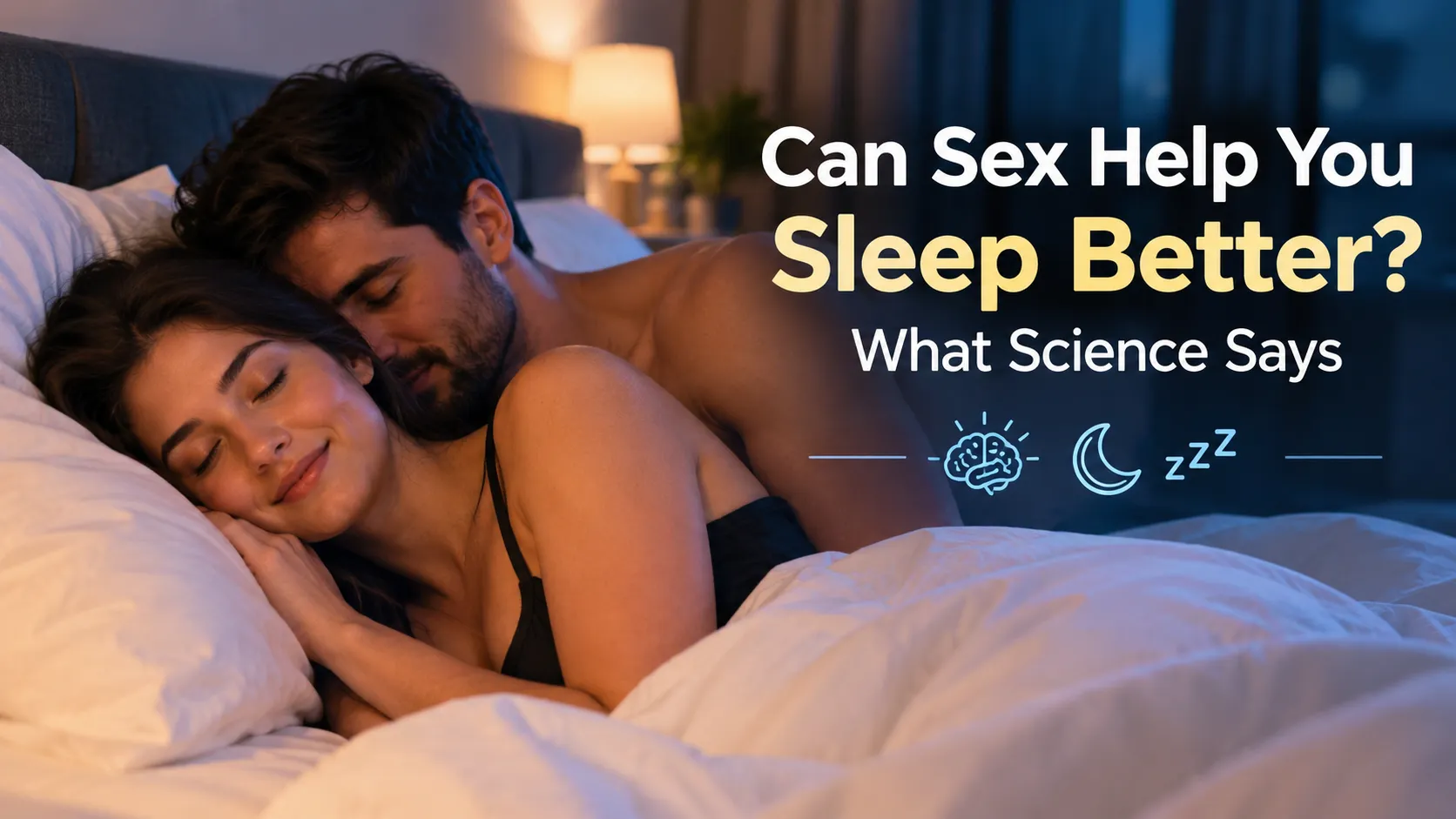
Few things are more frustrating than being exhausted but unable to fall asleep.
After a long day, the body may feel ready for bed while the mind continues replaying conversations, deadlines and tomorrow’s responsibilities. That is why people try everything from herbal tea and meditation to exercise, warm showers and strict bedtime routines.
Another question appears surprisingly often:
Can sex help you sleep better?
There is some scientific evidence suggesting that it can—particularly when consensual sexual activity is enjoyable, relaxing and includes orgasm.
But the answer is not as simple as saying, “Sex makes everyone sleep better.”
Research remains relatively limited. Different studies measure different kinds of sexual activity, many rely on self-reported sleep, and individual responses vary considerably.
The most accurate conclusion is therefore:
Sexual activity may help some adults relax, fall asleep more easily or experience better-quality sleep, but it should not be treated as a proven remedy for insomnia.
Understanding why requires looking at what sleep researchers have actually measured.
Health note: This article provides general educational information. Persistent or disruptive sleep problems should be discussed with a qualified healthcare professional.
What Does “Better Sleep” Actually Mean?
Sleep quality is more complicated than simply asking whether somebody slept for eight hours.
Researchers can measure several different outcomes.
Sleep Latency
Sleep latency is the amount of time between trying to sleep and actually falling asleep.
If one activity reduces sleep latency, it means participants tended to fall asleep faster afterward.
Sleep Efficiency
Sleep efficiency compares the amount of time spent asleep with the total amount of time spent in bed.
Someone who spends eight hours in bed but stays awake for large portions of the night has lower sleep efficiency than someone who sleeps through most of that period.
Wake After Sleep Onset
This measures how much time a person spends awake after initially falling asleep.
Frequent nighttime waking can leave people feeling tired even if they technically spent enough hours in bed.
Subjective Sleep Quality
Researchers also ask participants how well they believe they slept.
Subjective sleep quality matters because people’s experience of sleep is important, but it does not always match measurements from sleep-monitoring equipment.
These distinctions explain why two studies can appear to reach different conclusions without necessarily contradicting each other.
What Has Research Found About Sex and Sleep?
One of the most frequently cited studies was published in 2019 and surveyed 778 adults about sexual activity and subsequent sleep.
Participants generally perceived sexual activity involving orgasm—particularly partnered sexual activity—as being followed by more favourable sleep outcomes. Masturbation with orgasm was also perceived as helping sleep quality and sleep onset. However, this was a cross-sectional survey based on participants’ perceptions rather than an experiment proving that sexual activity caused better sleep.
A stronger design appeared in a 2023 Journal of Sleep Research study.
Researchers first surveyed participants and then followed them with daily diaries for 14 consecutive days.
The diary results were revealing.
Partnered sexual activity with orgasm was associated with shorter subjective sleep latency and better subjective sleep quality.
Sexual activity without orgasm was not associated with those improvements.
Interestingly, masturbation—with or without orgasm—also did not significantly predict better sleep in the diary data.
Then, a small pilot study published in 2025 added objective sleep monitoring.
Fourteen adults from seven cohabiting couples completed nights involving no sexual activity, masturbation and partnered sexual activity while researchers monitored sleep.
Both masturbation and partnered sexual activity were associated with improved sleep efficiency and reduced wakefulness after sleep onset compared with no sexual activity.
However, participants did not report significant differences in subjective sleep quality, and the sample was extremely small. They also attempted sleep later on sexually active nights.
Taken together, these studies suggest a possible beneficial relationship.
They do not prove a universal sleep effect.
Is Orgasm the Important Part?
Possibly—but the evidence is still developing.
The 2023 diary study found improved sleep outcomes specifically after partnered sexual activity involving orgasm.
That suggests orgasm may play some role in the relaxation process.
Earlier laboratory research also shows that orgasm produces measurable hormonal changes.
For example, prolactin concentrations rise substantially after orgasm in both men and women and can remain elevated for more than an hour. Researchers have investigated whether this contributes to the period of reduced arousal and relaxation that can follow orgasm.
But orgasm should not be turned into another sleep-performance target.
Trying to force a particular outcome can create pressure—the opposite of what someone needs when attempting to relax.
Sexual activity without orgasm may still be enjoyable and emotionally meaningful even if research has not consistently associated it with improved sleep.
The REST Framework: Why Sex Might Influence Sleep
A useful way to understand the relationship is through four factors:
Relaxation, Experience, Schedule and Treatment.
R — Relaxation
Sleep becomes difficult when the nervous system remains highly alert.
Stress about work, relationships, finances or the following day can contribute to insomnia symptoms. The National Heart, Lung, and Blood Institute identifies stress and worry as common contributors to sleep difficulty.
Enjoyable sexual activity may help some adults transition from an alert state into a calmer one.
That could involve physical relaxation, emotional closeness, changes in attention and physiological responses associated with orgasm.
The important phrase is “may help.”
Scientists have not identified one simple biological mechanism proving that sexual activity acts like a sleeping medication.
E — Experience and Emotional Context
Sexual activity is not experienced identically by everybody.
A comfortable encounter with a trusted partner can be relaxing.
An encounter involving anxiety, conflict, pressure, discomfort or fear can produce the opposite effect.
Relationship context may therefore matter as much as physical activity.
A 2026 daily-diary study examining partnered sexual activity and stress physiology found that sex was associated with healthier next-day cortisol patterns specifically among people who reported greater partner closeness. That suggests relationship context can influence physiological associations rather than sexual activity operating independently.
Good sleep and satisfying intimacy are both affected by emotional security.
S — Schedule and Sleep Opportunity
Even something relaxing can interfere with sleep if it pushes bedtime too late.
The 2025 pilot study found that participants attempted sleep significantly later after both masturbation and partnered sexual activity than on nights involving no sexual activity.
That creates an important practical distinction.
An activity might improve sleep efficiency after you get into bed while still reducing total sleep opportunity because you went to bed later.
If somebody needs to wake at 6:00 am, staying awake an additional hour cannot automatically be considered beneficial simply because they eventually slept efficiently.
Healthy sleep requires enough time.
A joint sleep-medicine consensus recommends that adults generally obtain at least seven hours of sleep regularly for optimal health.
T — Treat Persistent Problems Properly
Sexual activity can be part of a relaxing bedtime routine.
It is not a treatment for chronic insomnia, obstructive sleep apnea or another underlying sleep disorder.
If sleep problems occur frequently and interfere with daytime life, proper assessment matters.
NHLBI defines chronic insomnia as difficulty sleeping at least three nights per week for three months or longer.
Someone experiencing that pattern should not simply keep searching for increasingly powerful ways to become tired before bed.
What About Oxytocin, Cortisol and “Sleep Hormones”?
Articles about sex and sleep often provide a neat hormonal explanation.
Oxytocin rises.
Cortisol falls.
Prolactin rises.
Therefore, sleep improves.
Real physiology is more complicated.
Oxytocin is involved in social behaviour and sexual physiology, and research continues to investigate its relationship with stress and sleep.
However, a systematic review examining oxytocin-based interventions found that human clinical evidence showed little or no consistent direct sleep-promoting effect.
That does not mean oxytocin has no role.
It means scientists should not describe it as a proven natural sleeping pill.
Prolactin does reliably rise after orgasm, but its precise role in subsequent sleepiness remains less settled than popular wellness articles sometimes imply.
Hormonal changes are therefore biologically plausible pieces of the puzzle—not a complete explanation.
Partnered Sex vs Masturbation: Does One Help Sleep More?
Research has not produced a final answer.
The 2019 survey found that participants perceived both partnered orgasm and orgasm from masturbation as beneficial for sleep.
The 2023 diary study was different.
Only partnered sexual activity with orgasm predicted significantly shorter subjective sleep latency and better subjective sleep quality. Masturbation did not show the same diary association.
The 2025 objective pilot study then found improved sleep efficiency and less wakefulness after sleep onset following both partnered sex and masturbation.
So which is correct?
Potentially all three.
The studies measured different populations, outcomes and situations.
The most responsible conclusion is that both partnered and solo sexual activity may influence sleep, but current evidence is too limited to establish which reliably works better across the general population.
Can Sex Sometimes Make Sleep Worse?
Yes.
Any claim that sex automatically improves sleep ignores individual circumstances.
It Can Delay Bedtime
If sexual activity extends the evening considerably, total sleep duration may decrease.
Relationship Conflict Can Increase Stress
Sexual activity that occurs during unresolved conflict or under pressure may produce stress rather than relaxation.
Physical Discomfort Can Disrupt Sleep
Pain or discomfort associated with sexual activity should never simply be accepted as normal if it is persistent or concerning.
Alcohol Can Confuse the Picture
People sometimes combine intimacy with alcohol and then attribute sleepiness to sexual activity.
Alcohol may initially make falling asleep easier, but NHLBI notes that it can produce lighter, more disrupted sleep later in the night.
Performance Anxiety Can Increase Alertness
If someone starts thinking, “I must have sex or I will not sleep,” a relaxing activity can become another source of pressure.
Sleep works poorly when it becomes a performance test.
Sleep and Sexual Health Work in Both Directions
The relationship is not simply:
Sex → better sleep.
Sleep can also influence sexual wellbeing.
Poor sleep, sleep deprivation and sleep disorders have been associated with lower sexual desire, sexual dysfunction and relationship difficulties.
Obstructive sleep apnea has also been associated with sexual dysfunction, including erectile difficulties in men.
That creates a potentially bidirectional relationship:
Healthy sleep can support sexual wellbeing, while satisfying sexual experiences may sometimes support relaxation and sleep.
Neither should be viewed as a guaranteed treatment for the other.
Sex Should Not Be Marketed as an Insomnia Treatment
This point is particularly important on commercial adult websites.
Readers may arrive at wellness content after searching for relationships, dating, Bangalore escorts, Bangalore Call Girls or adult companionship brands such as Classy Bangalore Escorts.
That commercial context should remain separate from medical advice.
No companionship provider should promise that booking a companion will treat insomnia, anxiety or another health condition.
A social experience may feel relaxing.
Conversation may improve someone’s evening.
Consensual sexual activity may sometimes be followed by better sleep.
None of those observations establishes a medical treatment.
If someone has persistent insomnia, repeated nighttime waking, severe snoring with breathing interruptions, excessive daytime sleepiness or another significant sleep problem, medical evaluation is more appropriate.
Better Sleep Still Depends on the Basics
Even if sexual activity helps you unwind, established sleep habits remain important.
NHLBI recommends approaches such as:
- Keeping a reasonably consistent bedtime and wake time
- Making the bedroom dark, cool and quiet
- Limiting bright screens before bed
- Avoiding caffeine, nicotine and alcohol close to bedtime
- Maintaining regular daytime physical activity
- Developing a relaxing evening routine
- Giving yourself enough opportunity to sleep
Sexual activity can potentially fit within that routine.
It should not replace it.
A Practical “Will This Help My Sleep?” Checklist
Before treating intimacy as part of your bedtime wind-down, consider the following:
Do I actually find it relaxing?
If sexual activity energizes rather than relaxes you, your response is valid.
Is it consensual and comfortable?
Anxiety and pressure undermine relaxation.
Am I protecting enough sleep time?
Do not sacrifice two hours of sleep opportunity in pursuit of a possible improvement in sleep efficiency.
Am I relying on alcohol?
Alcohol can undermine sleep quality later in the night.
Am I turning orgasm into another performance goal?
Pressure can make both intimacy and sleep more difficult.
Do I have an ongoing sleep problem?
Persistent insomnia deserves proper evaluation rather than self-treatment.
Frequently Asked Questions
Can sex really help you fall asleep faster?
Possibly. A 2023 diary study found that partnered sex with orgasm was associated with shorter subjective sleep latency. However, responses vary and larger studies are still needed.
Does orgasm help with sleep?
Research suggests orgasm may be relevant. Partnered sexual activity involving orgasm has been associated with better subsequent sleep in several studies, although the mechanism is not completely established.
Does sex without orgasm improve sleep?
Evidence is less convincing. In the 2023 diary study, sexual activity without orgasm was not associated with significant improvements in sleep latency or sleep quality.
Can masturbation help you sleep?
Possibly, but evidence is mixed. A 2025 pilot found improved objective sleep efficiency following masturbation, while a larger 2023 diary study found no significant improvement associated with masturbation.
Why do some people feel sleepy after orgasm?
Hormonal changes, physical relaxation, reduced arousal and psychological factors may contribute. Prolactin rises substantially after orgasm, but no single hormone fully explains post-orgasm sleepiness.
Does oxytocin make you sleep?
Oxytocin is involved in social and sexual physiology and may interact with stress and sleep systems, but human evidence does not support describing it as a reliable sleep-inducing hormone.
Is partnered sex better for sleep than masturbation?
Some studies favour partnered sex, while newer objective research has observed benefits after both. Current evidence is insufficient to declare one universally superior.
Can sex cure insomnia?
No. Sexual activity is not an established medical treatment for insomnia.
When should I speak to a doctor about poor sleep?
Seek professional advice if sleep difficulties are persistent, interfere with daytime functioning or occur frequently. Chronic insomnia generally involves difficulty sleeping at least three nights per week for three months or longer.
How much sleep do adults need?
Major sleep-medicine organizations generally recommend at least seven hours of sleep per night for healthy adults on a regular basis. Individual needs can vary.
The Bottom Line
So, can sex help you sleep better?
For some adults, probably yes.
Research suggests that enjoyable partnered sexual activity—particularly when orgasm occurs—can be associated with falling asleep more easily and reporting better sleep quality.
A small 2025 study using objective sleep monitoring also found improved sleep efficiency and less wakefulness after both partnered sex and masturbation.
But the evidence remains limited.
Studies are relatively small, different methods produce different results, and scientists have not demonstrated that sexual activity reliably improves sleep for everybody.
Nor is there evidence that booking companionship should be used as a treatment for insomnia.
The most useful way to think about the relationship is the REST framework:
Relaxation. Experience. Schedule. Treatment.
If consensual intimacy helps you unwind, fits naturally into your evening and does not reduce the amount of time available for sleep, it may form part of a healthy bedtime routine.
But good sleep still depends on fundamentals such as sufficient sleep opportunity, a stable schedule, a suitable environment and appropriate treatment when a sleep disorder exists.
Sex may help some people sleep.
It is not a substitute for sleep medicine.
And that distinction is what the science currently supports.





Leave a Reply