
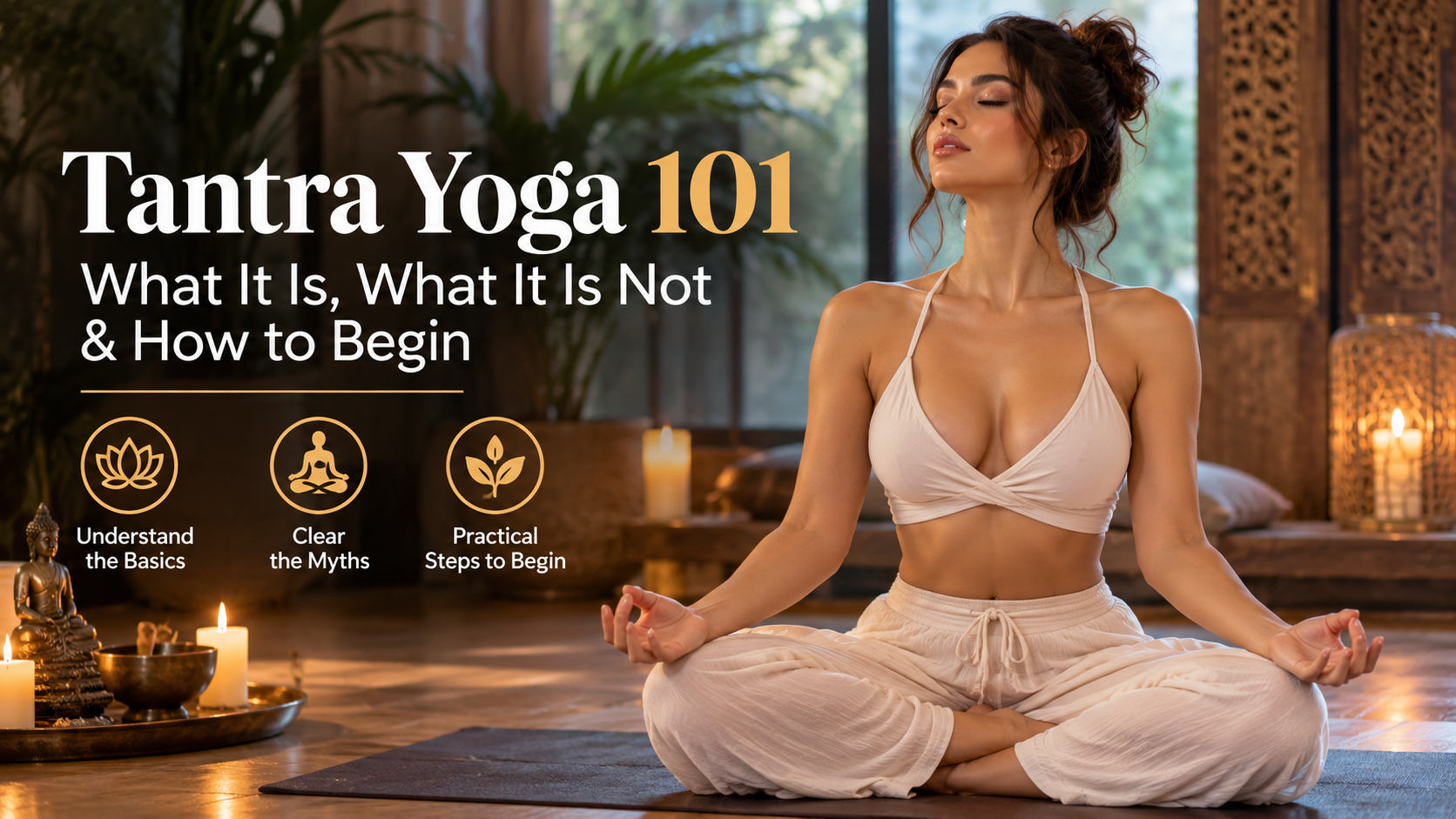
Search for tantric yoga and you are likely to find very different interpretations.
Some articles show partner yoga poses.
Others focus on chakras, Kundalini and meditation.
Some describe Tantra almost entirely through relationships, while others approach it as a philosophical or spiritual tradition.
That variation can make Tantra Yoga difficult to understand, particularly for a beginner.
The reason is relatively simple: Tantra was never one single practice, and the modern term “Tantra Yoga” is now used much more broadly than historical tantric traditions used their own terminology.
A useful introduction therefore needs to separate three things:
historical Tantra;
yogic practices influenced by Tantra;
and
modern Tantra-inspired wellness practices.
Once those categories are clear, Tantra Yoga becomes much easier to understand.
What Is Tantric Yoga?
Tantric yoga is a broad term for yogic practices influenced by tantric philosophy, contemplative methods or ritual traditions.
Depending on the school or teacher, a practice may include:
- meditation
- mantra
- breathing exercises
- physical yoga postures
- visualization
- mudra
- subtle-body concepts
- contemplative ritual
There is no universally standardized sequence called Tantra Yoga.
One teacher may emphasize meditation.
Another may combine slow physical yoga with mantra and breathing.
Another may work primarily with traditional philosophical material.
A contemporary partner workshop may use the word Tantra in a completely different way.
That diversity is important because it prevents one modern interpretation from being mistaken for the entire tradition.
What Tantra Yoga Is Not
Before looking at its practices, it helps to remove some common misconceptions.
Tantric Yoga is not automatically:
- sexual
- performed with a partner
- a special collection of yoga positions
- massage
- advanced flexibility training
- a guaranteed method of awakening Kundalini
- medical treatment
- one standardized spiritual system
Some of these ideas have connections with particular historical or modern Tantra traditions.
None defines Tantra Yoga as a whole.
Is Tantric Yoga Mainly About Sex?
No.
This is probably the most persistent misunderstanding surrounding Tantra.
Certain historical tantric traditions included specialized sexual rituals.
Those practices existed and should not be erased from the historical record.
But they represented only one part of a much larger religious and philosophical landscape.
Tantric traditions also developed sophisticated approaches involving:
mantra;
meditation;
deity visualization;
ritual;
subtle-body practices;
breathing;
initiation;
and philosophical contemplation.
Modern popular culture often gives sexuality far more attention than these other elements.
As a result, many beginners encounter a distorted version of Tantra before they encounter its wider history.
Do You Need a Partner for Tantra Yoga?
No.
Tantric Yoga can be practised entirely alone.
Solo practices might include:
meditation;
asana;
breathing;
mantra;
visualization;
or contemplative exercises.
Partner Tantra Yoga does exist.
Modern partner classes sometimes use:
shared breathing;
supported movement;
eye contact;
mirrored postures;
or communication exercises.
These can be meaningful contemporary practices.
They should simply not be treated as the definition of Tantra Yoga itself.
Is There an Official Set of Tantric Yoga Poses?
No universal list exists.
This is important because online searches often make it appear that certain physical positions belong exclusively to Tantra Yoga.
In reality, many postures used in modern tantric-style classes also appear in:
Hatha Yoga;
Vinyasa;
Yin Yoga;
general beginner yoga.
The difference may lie less in the posture and more in how it is practised.
A teacher might ask students to hold a familiar position more slowly while paying attention to:
breathing;
physical sensation;
mental reactions;
visualization;
or mantra.
The posture therefore becomes part of a wider contemplative practice.
What Does “Tantra” Actually Mean?
The Sanskrit word tantra has been used in several historical contexts.
It can refer to systems, frameworks, methods or texts.
Modern teachers sometimes explain Tantra as “weaving together” different aspects of experience.
That metaphor can be useful.
But it should not be mistaken for the complete historical meaning of the term.
Tantra developed through diverse South Asian religious traditions rather than beginning as one modern wellness philosophy.
Tantra Before Modern Yoga Studios
Tantric traditions became influential within several forms of Hinduism and Buddhism.
Their practices could include:
ritual;
mantra;
meditation;
visualization;
initiation;
deity worship;
subtle-body techniques;
and forms of yoga.
Different communities developed different approaches.
There was no single tantric organization creating one universal curriculum.
This is one reason modern claims such as:
“Ancient Tantra Yoga always followed these seven steps”
should be treated carefully.
Historical Tantra was much more diverse.
The Relationship Between Tantra and Yoga
Tantra and yoga have deeply overlapping histories.
But neither statement below is accurate:
“Tantra invented all yoga.”
or
“Tantra and yoga are completely unrelated.”
Yoga traditions existed before mature tantric systems developed.
At the same time, later yogic traditions—particularly medieval forms of Hatha Yoga—developed in environments where tantric practices and ideas were influential.
Concepts involving:
Kundalini;
chakras;
nadis;
mantra;
mudra;
and subtle-body practice
became especially important in later yoga traditions.
The history is therefore one of interaction rather than a simple one-way origin story.
Eight Practices Commonly Associated With Tantric Yoga
Modern Tantra Yoga can look very different depending on the teacher.
However, several practice families appear frequently.
1. Asana
Asana refers to physical posture.
In a modern Tantra Yoga class, postures may be used less as athletic goals and more as tools for attention.
You might be asked to notice:
how breathing changes;
where tension appears;
how quickly the mind becomes impatient;
how different sides of the body feel.
This changes the emphasis from:
“How impressive is my pose?”
to:
“What am I noticing while I practise?”
2. Meditation
Meditation is central to many forms of Tantra-inspired yoga.
A teacher may guide attention toward:
breath;
physical sensation;
sound;
a symbolic image;
a mantra;
or awareness itself.
Meditation can be brief or highly developed depending on the tradition.
For beginners, simple practices are usually more useful than trying to reproduce complex historical techniques without instruction.
3. Mantra
Mantra has played a major role in many tantric traditions.
A mantra may be:
a sacred syllable;
a phrase;
a devotional formula;
or a focus for meditation.
Modern classes often use mantra more openly than traditional initiatory systems did.
Repeated sound can help provide structure for attention.
You do not need to understand mantra as a magical formula in order to appreciate its meditative function.
4. Pranayama
Pranayama refers broadly to breath regulation.
Modern Tantra Yoga may include:
slow breathing;
alternate-nostril breathing;
controlled breathing patterns;
or other methods.
Beginners should approach stronger breathwork gradually.
Feeling dizzy or distressed is not evidence that a technique is “working more deeply.”
Comfortable breathing is a perfectly legitimate starting point.
5. Mudra
Mudra is commonly translated as gesture or seal.
Many people recognize mudras as hand positions used during meditation.
Historically, the term can have broader meanings.
In a contemporary Tantra Yoga class, mudra may be combined with:
breathing;
meditation;
mantra;
or visualization.
6. Bandha
Bandhas are often described as bodily locks.
Modern yoga commonly discusses areas around the:
pelvic floor;
abdomen;
throat.
These techniques can become quite subtle.
A beginner does not need to force strong muscular contractions or breath retention to participate in Tantra-inspired yoga.
7. Visualization
Visualization is an important aspect of Tantra that is frequently missing from pose-focused explanations.
Traditional practices could involve visualization of:
deities;
symbols;
sacred diagrams;
light;
subtle-body structures;
or Sanskrit syllables.
Modern teachers may simplify this into imagery such as observing light moving with the breath.
The simplified practice can still be useful without being presented as an unchanged historical ritual.
8. Ritual
Historical Tantra was often deeply ritualized.
That is one of the biggest differences between traditional tantric practice and many modern yoga classes.
Traditional contexts could include:
mantra;
offerings;
sacred diagrams;
visualization;
symbolic gestures;
deity invocation.
Most modern yoga studios include only a small fraction of this material.
Their classes may therefore be better understood as Tantra-influenced yoga rather than complete traditional tantric practice.
Chakras and Tantra Yoga
Chakras are commonly associated with Tantra.
But the subject is more complex than the familiar seven-colour diagram suggests.
Historical traditions described different chakra systems.
Different texts could use different:
numbers;
locations;
symbols;
deities;
mantras.
The modern seven-chakra model is influential, but it should not be presented as the only system that ever existed.
Chakras are best approached as part of traditional subtle-body frameworks rather than as physical organs recognized by modern anatomy.
What Are Nadis?
Nadis are subtle channels described within yogic traditions.
Three names frequently encountered are:
ida
pingala
and
sushumna.
These belong to subtle-body models.
They should not be described as ordinary anatomical structures such as veins or nerves.
A practitioner may still find the imagery useful for meditation without needing to turn it into a biomedical claim.
What Is Kundalini?
Kundalini is one of the most famous concepts associated with Tantra and later yoga traditions.
It is commonly described as a latent spiritual power associated with the base of the subtle body.
Modern wellness culture often presents Kundalini awakening dramatically.
A responsible approach is more cautious.
Intense breathing, prolonged meditation, fasting or sleep disruption can produce powerful psychological and physical experiences.
Beginners should not deliberately chase extreme states.
Tantric Yoga does not require a dramatic Kundalini experience to be meaningful.
Shiva and Shakti
Tantric discussions often refer to Shiva and Shakti.
In some Hindu tantric philosophies, Shiva may represent consciousness while Shakti represents dynamic power.
Modern explanations sometimes reduce this to:
Shiva = masculine
and
Shakti = feminine.
That can be misleading.
These concepts have theological and philosophical meanings that extend far beyond biological sex or gender stereotypes.
Anyone can engage with the ideas.
Is Tantra Yoga Religious?
It can be.
Traditional tantric lineages may involve:
religious devotion;
deities;
ritual;
scripture;
initiation;
teacher-disciple relationships.
Modern classes may contain very little of this.
Instead, they may focus on:
breathing;
movement;
meditation;
mindfulness;
personal reflection.
Neither format should pretend to be the other.
Before attending a class, ask what it actually includes.
Is Tantra Yoga a Workout?
Sometimes.
But physical exercise is not the defining feature.
A Tantra-inspired class may involve long periods of:
sitting;
meditation;
slow movement;
breathing;
mantra.
If your main goal is an intense cardiovascular workout, another yoga style may provide a more predictable experience.
If your interest is attention, embodiment and contemplative practice, Tantra Yoga may be more relevant.
Tantra Yoga vs Hatha Yoga
These terms overlap historically but are not interchangeable.
Traditional Hatha Yoga developed through medieval yogic environments that interacted strongly with tantric ideas.
Modern studio “Hatha Yoga,” however, often simply refers to slower physical yoga.
A Tantra Yoga class may incorporate Hatha postures while adding:
mantra;
visualization;
meditation;
subtle-body concepts;
or ritual.
Always judge the actual class rather than relying only on the label.
Tantra Yoga vs Kundalini Yoga
Kundalini concepts have strong connections with tantric traditions.
But modern Kundalini Yoga and Tantra Yoga should not automatically be treated as identical systems.
Both may use:
breathing;
mantra;
meditation;
subtle-body ideas.
Their teaching methods and historical contexts can still differ considerably.
Tantra Yoga vs Yin Yoga
Yin Yoga is a modern style based heavily on longer-held floor postures.
Tantra Yoga is a broader contemplative category.
A modern Tantra teacher may borrow slower postures associated with Yin.
That does not make Yin Yoga historically tantric.
Tantra Yoga vs Partner Yoga
Partner yoga involves two people practising together.
It may include:
supported postures;
shared stretches;
balance;
eye contact;
synchronized breathing.
Some modern teachers describe these practices as tantric partner yoga.
That can be a useful contemporary format.
But Tantra Yoga does not require another person.
Solo Tantra Yoga
Beginners may find solo practice especially useful because it removes many misconceptions around Tantra.
A simple solo practice can involve:
gentle movement;
breathing;
meditation;
mantra;
reflection.
You can begin by observing your own:
attention;
breathing;
physical sensation;
restlessness.
No partner is necessary.
Modern Partner Practice
Partner practice introduces communication.
For example, two people may practise:
mirrored movement;
comfortable shared breathing;
supported stretches;
seated meditation.
Good partner practice should always include clear consent.
Nobody should be pressured into:
touch;
eye contact;
proximity;
or a particular exercise.
A person should be free to modify or stop without being told that refusal indicates a spiritual problem.
Traditional Tantra vs Neo-Tantra
This distinction explains much of the confusion surrounding Tantra today.
Traditional Tantra
Traditional systems may involve:
scripture;
initiation;
mantra;
deity practice;
ritual;
yoga;
meditation;
philosophy.
Neo-Tantra
Neo-Tantra is a broad modern development influenced by Tantra but also shaped by:
Western spirituality;
psychology;
relationship work;
embodiment practices;
personal-development culture.
Modern Neo-Tantra often places much greater emphasis on relationships and sexuality than many historical tantric traditions did.
That does not automatically make Neo-Tantra invalid.
It makes it modern.
Problems arise when a modern practice is presented as an unchanged ancient tradition.
What Happens in a Modern Tantra Yoga Class?
There is no fixed answer.
A class might begin with seated meditation.
The teacher may then introduce:
breathing;
slow postures;
mantra;
visualization;
quiet reflection.
Another class might emphasize philosophy.
Another might use partner exercises.
The label “Tantra Yoga” therefore tells you less than the actual class description.
Before attending, ask:
Is the practice solo or partnered?
Is physical touch included?
How physically demanding is it?
Is mantra used?
Is there religious content?
Is intense breathwork included?
That is especially important for beginners.
A Simple 20-Minute Tantra-Inspired Practice
You do not need an advanced ritual to explore some of the basic ideas.
First 3 Minutes: Arrive
Sit comfortably.
Notice your surroundings.
Feel the weight of the body.
Pay attention to breathing without immediately changing it.
Minutes 3–7: Comfortable Breathing
Allow breathing to slow naturally.
Do not force long breath holds.
Simply observe the inhale and exhale.
Minutes 7–12: Gentle Movement
Move through several familiar postures slowly.
The particular shapes matter less than your attention.
Notice:
balance;
tension;
breath;
mental reactions.
Minutes 12–16: Focus
You might use:
a simple mantra;
a repeated phrase;
or breath awareness.
Minutes 16–20: Stillness
Sit or lie comfortably.
Observe what remains when movement stops.
This is not a complete traditional tantric practice.
It is a beginner-friendly way to explore a Tantra-inspired emphasis on integration and attention.
A Seven-Day Beginner Introduction
Beginners often learn more by exploring one element at a time.
Day 1 — Attention
Sit quietly for ten minutes.
Notice sensory experience.
Day 2 — Breath
Practise comfortable breathing.
Day 3 — Movement
Move slowly through familiar postures.
Day 4 — Mantra
Experiment with repeated sound or a contemplative phrase.
Day 5 — Visualization
Use simple imagery.
Day 6 — Integration
Combine movement, breathing and meditation.
Day 7 — Reflection
Ask what you actually noticed.
Which practice improved concentration?
Which felt forced?
What would you like to understand better?
Learning Tantra Yoga should involve curiosity, not pressure to produce extraordinary experiences immediately.
What Are the Benefits of Tantra Yoga?
This question needs careful wording.
Research on yoga and meditation more broadly has explored potential benefits related to:
stress;
wellbeing;
mobility;
sleep;
anxiety;
and physical function.
But general yoga research does not prove that every modern Tantra Yoga system produces unique physiological effects.
A more realistic expectation is that practices involving:
movement;
breathing;
meditation;
focused attention
may help some people feel:
calmer;
more physically aware;
less distracted;
or more reflective.
Those outcomes are meaningful without making exaggerated claims.
Tantra Yoga and Body Awareness
Modern life can become highly cognitive.
Many people spend much of the day working through:
screens;
messages;
meetings;
notifications;
planning.
A slower physical practice directs attention back toward sensation.
You may notice:
shoulder tension;
breathing patterns;
balance;
restlessness;
how difficult it is to remain still.
That increased awareness is one of the most accessible aspects of Tantra-inspired yoga.
Tantra Yoga and Mindfulness
Tantra Yoga and mindfulness are not historically identical.
But modern Tantra-influenced classes frequently cultivate present-moment attention.
During practice, you might observe:
breath;
movement;
physical sensation;
sound;
mental activity.
The objective is not necessarily to stop thinking.
It is to notice experience more clearly.
Can Tantra Yoga Reduce Stress?
It may help some people relax.
That benefit may come from several ordinary elements:
slower breathing;
physical movement;
meditation;
time away from devices;
focused attention.
Tantra Yoga should not be presented as guaranteed treatment for chronic anxiety or significant psychological distress.
Professional healthcare remains appropriate when needed.
Can Tantra Yoga Heal Trauma?
This is an area where marketing frequently becomes irresponsible.
Yoga, meditation and body-awareness practices may feel supportive for some people.
That does not mean a general yoga teacher is qualified to treat psychological trauma.
A teacher should not promise to:
release all stored trauma;
cure PTSD;
or diagnose psychological conditions.
Trauma-related care belongs within appropriately qualified professional practice.
Can Tantra Yoga Balance Hormones?
Claims that yoga permanently “balances hormones” are usually much more definite than the evidence supports.
Hormonal systems are complex.
A relaxing practice can contribute to general wellbeing without becoming an endocrine treatment.
If someone has symptoms suggesting a hormonal or medical condition, proper clinical assessment is more appropriate than relying solely on yoga claims.
Is Tantra Yoga Safe?
Gentle yoga, meditation and comfortable breathing are accessible for many adults.
But not every practice is equally suitable for everyone.
Take additional care with:
forceful breathwork;
long breath retention;
extreme flexibility;
advanced inversions;
intense fasting;
prolonged meditation;
strong bandha practices.
More intense does not automatically mean more authentic.
How to Choose a Tantra Yoga Teacher
Because Tantra Yoga is not one regulated international system, teacher selection matters.
Ask about:
their training;
the tradition they draw from;
whether the class is solo or partner-based;
touch policies;
breathing techniques;
religious content;
beginner suitability.
A good teacher should be able to explain what they mean by “Tantra Yoga” without becoming defensive.
Teacher Red Flags
Be cautious if a teacher:
guarantees enlightenment;
claims to cure serious disease;
pressures students into touch;
dismisses boundaries as emotional blockage;
claims exclusive access to the only authentic Tantra;
discourages healthcare;
uses spiritual authority to override consent.
Spiritual terminology does not eliminate the need for professional boundaries.
Tantra Yoga and Modern Bodywork
One reason Tantra is so frequently misunderstood is that the word now appears across several different wellness categories.
You may encounter:
Tantra Yoga;
Neo-Tantra workshops;
meditation;
relationship programmes;
bodywork;
massage.
These practices can share themes such as:
awareness;
breathing;
embodiment;
slowness;
attention.
But they should not be treated as identical.
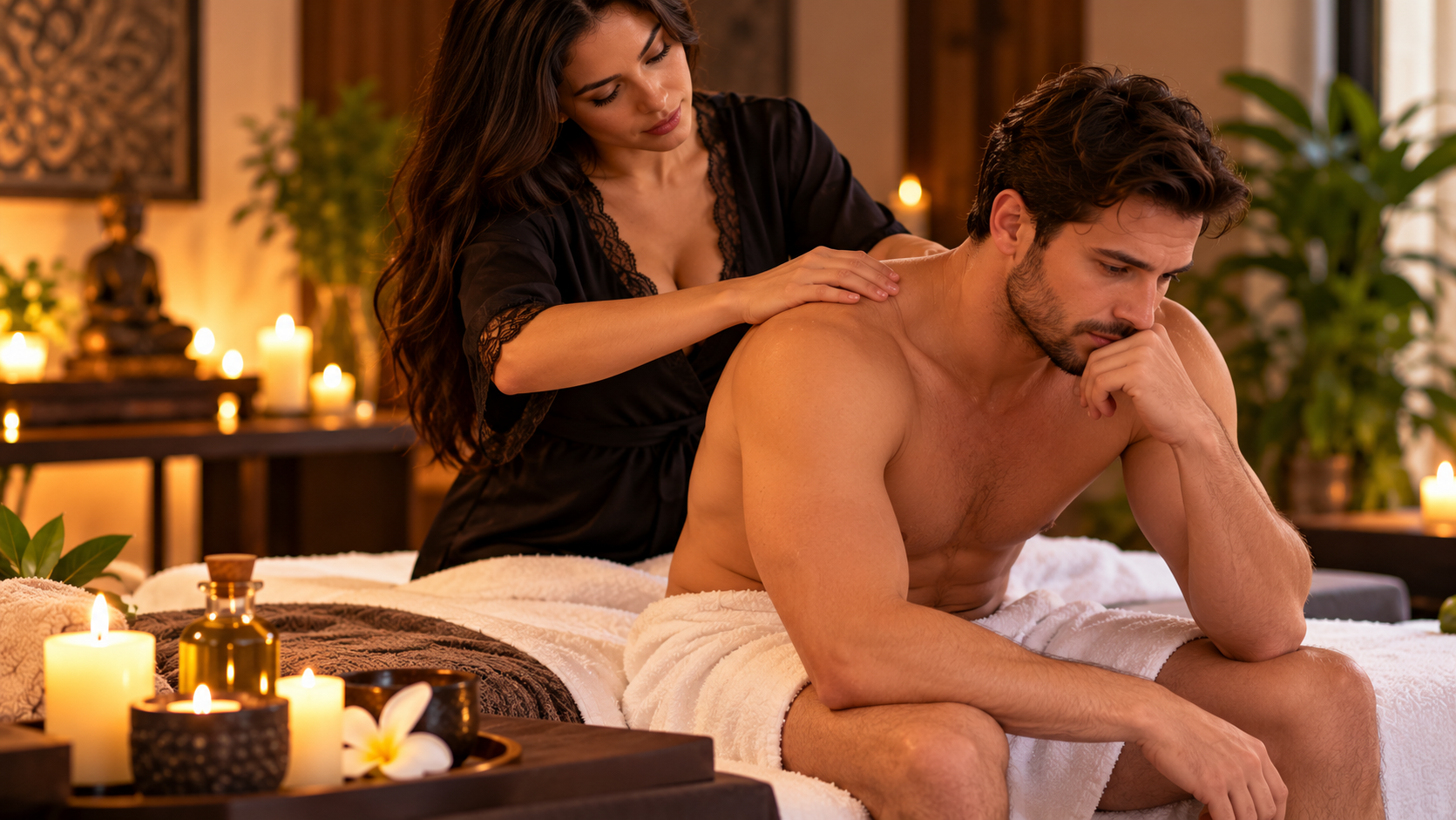
For example, somebody researching tantric massage in London is usually looking for practitioner-delivered bodywork rather than a yoga class.
Specialist providers such as Tantric Massage approach the subject through contemporary bodywork, while Tantra Yoga remains an active practice involving movement, meditation or other yogic methods.
That distinction helps people choose the experience that actually matches their intention.
Tantra Yoga vs Tantric Massage
The simplest difference is:
Tantra Yoga is something you practise.
Massage is something you receive from a practitioner.
Tantra Yoga may use:
asana;
breathing;
mantra;
meditation;
visualization.
Contemporary tantric massage may incorporate:
body awareness;
mindfulness;
breathing awareness;
slow pacing.
There is conceptual overlap.
There is not practical equivalence.
Can Massage and Tantra Yoga Complement Each Other?
Some adults may enjoy both practices as part of a wider wellbeing routine.
Yoga offers an active way to explore:
movement;
breathing;
concentration.
Massage provides a passive experience of:
rest;
bodywork;
physical attention.
There is no requirement to combine them.
But understanding the distinction prevents unrealistic expectations from either one.
Tantra Yoga in London
London’s wellness scene includes everything from highly traditional yoga schools to contemporary spiritual workshops.
That variety is useful.
It also means “Tantra Yoga” can refer to very different experiences.
A London class might focus mainly on:
meditation;
traditional philosophy;
slow physical practice;
Neo-Tantra;
or partner exercises.
Read beyond the headline.
The most useful question is:
“What will I actually be doing in this class?”
Frequently Asked Questions
What is tantric yoga?
Tantric yoga is a broad term for yogic practice influenced by tantric traditions or ideas. It may include meditation, movement, mantra, breathing, visualization and subtle-body concepts.
Is tantric yoga sexual?
Not inherently.
Sexual practices appeared in certain tantric traditions and feature heavily in some modern Neo-Tantra systems, but they do not define Tantra Yoga as a whole.
Do I need a partner?
No.
Many tantric practices are entirely individual.
Are there specific tantric yoga poses?
There is no single universal list.
Many poses used in modern Tantra Yoga also appear in other yoga traditions.
Is Tantra Yoga suitable for beginners?
It can be.
Choose a beginner-friendly class with clear teaching and realistic expectations.
Do I need to be flexible?
No.
Flexibility is not a measure of spiritual development.
Is Tantra Yoga religious?
It can be.
Traditional lineages may be explicitly religious, while modern classes may be more secular.
What are chakras?
Chakras are subtle centres described within particular yogic and tantric traditions.
Are chakras physical organs?
No.
They belong to subtle-body frameworks rather than conventional anatomical models.
What is Kundalini?
Kundalini is a concept of latent spiritual power found within several tantric and yogic traditions.
Does everyone experience Kundalini awakening?
No.
Nor is dramatic spiritual experience required for meaningful practice.
What is mantra?
Mantra is a sacred or contemplative sound, syllable or phrase.
What is pranayama?
Pranayama refers to methods of regulating the breath.
What is a mudra?
A mudra is a gesture or seal used in different yogic and ritual contexts.
What is a bandha?
A bandha is a bodily lock or seal associated with certain yoga practices.
Is Tantra Yoga the same as Hatha Yoga?
No.
Their histories overlap significantly, but the terms describe different traditions and modern teaching categories.
Is Tantra Yoga the same as Kundalini Yoga?
No.
There may be overlapping practices, but they are not interchangeable labels.
Is Tantra Yoga the same as couples yoga?
No.
Partner Tantra Yoga is one modern form of practice.
Is tantric massage the same as Tantra Yoga?
No.
Massage is practitioner-delivered bodywork, while yoga is an active practice.
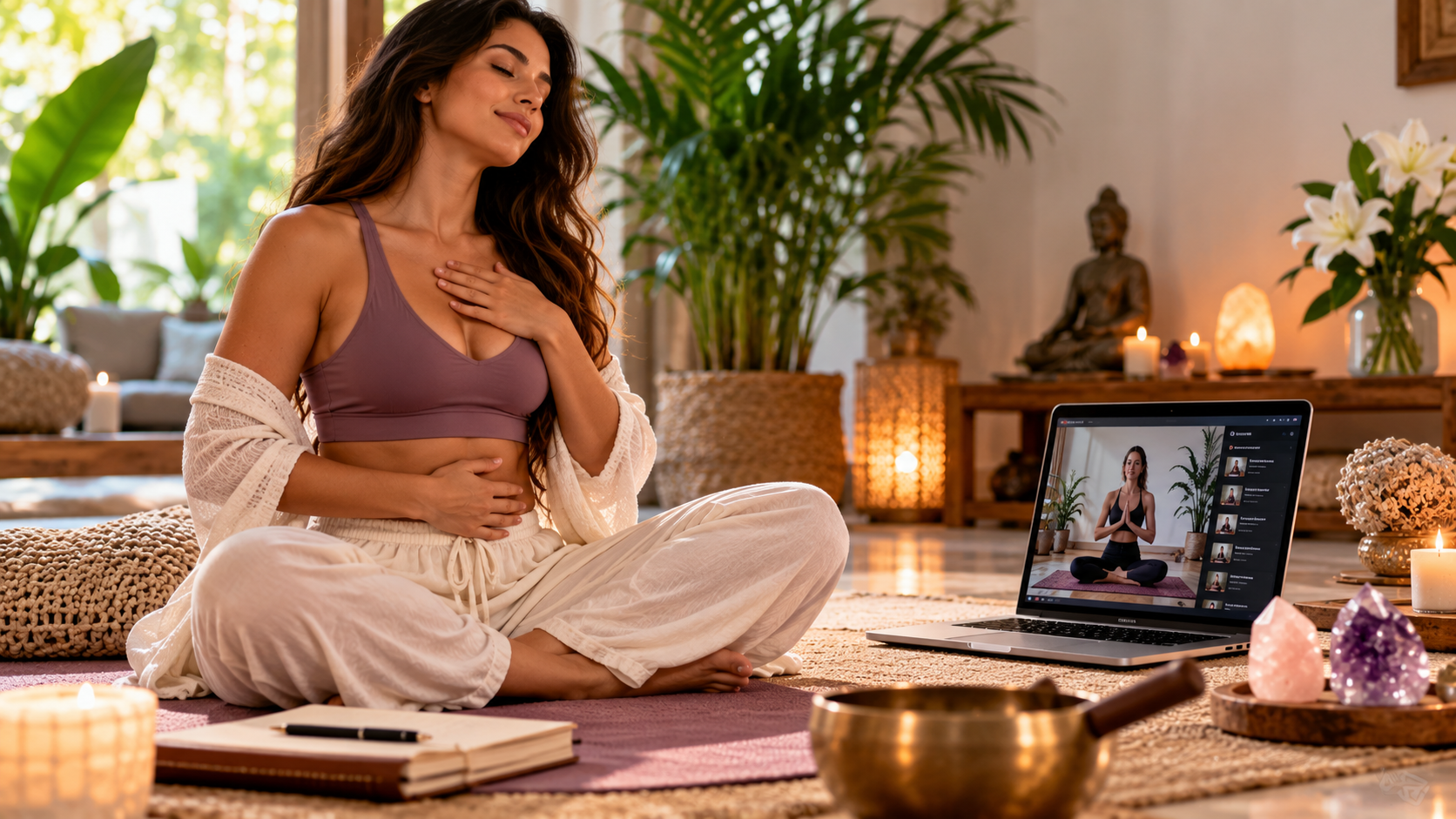
Can I practise at home?
Basic meditation, gentle movement and comfortable breathing can be explored at home.
Advanced practices may benefit from qualified guidance.
How long should a beginner practise?
Even 10 to 20 minutes is enough for an introductory practice.
What should I wear?
Comfortable clothing that allows easy movement.
Do I need special equipment?
Usually not.
A mat and basic yoga props are sufficient for many beginner practices.
How do I choose a teacher?
Look for transparent training, clear boundaries, realistic claims and a clear description of what the class involves.
What if I do not want partner exercises?
You should be able to decline.
A responsible teacher will respect that.
Is Neo-Tantra the same as traditional Tantra?
No.
Neo-Tantra is a modern development influenced by historical Tantra alongside psychology, relationship work and contemporary spirituality.
Can Tantra Yoga cure anxiety?
It should not be presented as a guaranteed medical treatment.
Can Tantra Yoga heal trauma?
General yoga teachers should not claim to cure psychological trauma unless appropriately clinically qualified.
Can Tantra Yoga improve relationships?
Meditation and communication practices may support useful skills, but no yoga system guarantees a successful relationship.
Is Tantra Yoga connected with massage?
They can share modern themes such as embodiment and awareness, but the practices themselves remain distinct.
What Tantra Yoga Is and Is Not
If you remember nothing else, remember this distinction.
Tantra Yoga can be:
meditative;
physical;
philosophical;
ritual;
mantra-based;
breath-focused;
individual;
or, in some modern systems, partnered.
Tantra Yoga is not automatically:
sexual;
massage;
couples yoga;
a collection of unusual positions;
a medical treatment;
a guaranteed Kundalini-awakening system.
That distinction removes most of the confusion surrounding the subject.
Final Thoughts
Tantra Yoga becomes much more interesting once it is separated from the stereotypes surrounding it.
It does not require unusual physical positions.
It does not require a partner.
It cannot be reduced to sexuality.
And it does not need exaggerated medical claims to justify its value.
Tantric traditions developed complex approaches involving:
meditation;
mantra;
ritual;
visualization;
breathing;
subtle-body systems;
and yoga.
Modern Tantra Yoga draws from that much larger history in different ways.
Some teachers stay relatively close to philosophical or contemplative traditions.
Others combine Tantra with contemporary Hatha Yoga.
Others work within modern Neo-Tantra.
That variation is why the most useful question is not:
“What is the one correct Tantra Yoga routine?”
It is:
“What does this teacher mean by Tantra Yoga, and what will I actually practise?”
From there, beginners can explore Tantra without either romanticising it or dismissing it.
Move slowly.
Learn the history.
Ask questions.
Respect physical limits.
Pay attention to boundaries.
And distinguish traditional concepts from modern interpretations.
Those habits will take you much further than searching for a supposedly secret pose or dramatic spiritual shortcut.





Leave a Reply