

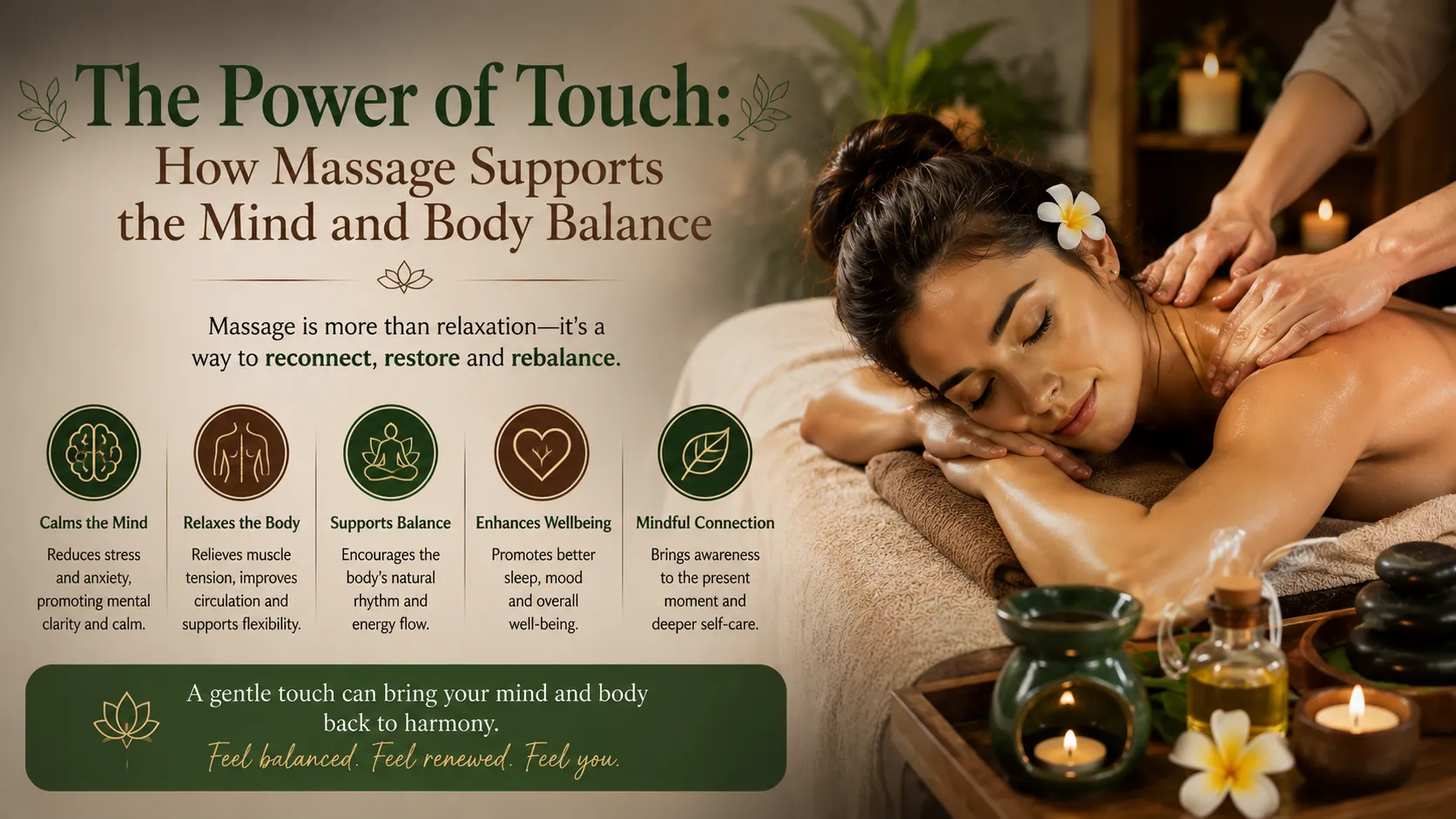
Touch can support mind and body balance when it gives a person clear, manageable sensations to notice in a setting where they feel informed, comfortable and free to respond. Massage may help some adults step away from mental noise and become more aware of physical comfort, tension, breathing and pace. The experience varies, however, and it should complement rather than replace appropriate healthcare.
That distinction matters. “Balance” is often used as if it were a permanent state that a therapist can deliver. Real life is more dynamic. The mind shifts between planning, remembering and reacting, while the body responds to work, travel, sleep, movement and temperature. Massage does not freeze that activity. It may create an interval in which those signals become easier to notice.
For someone in London, this interval can feel particularly valuable. A journey may involve crowded platforms, traffic, alerts, deadlines and rapid changes of attention before the appointment has even begun. The most supportive session therefore depends on more than technique. Clear booking information, an appropriate setting, consultation, consent, adaptable pressure and recovery time all shape whether touch feels settling or simply becomes one more demand.
Mind and body balance is coordination, not perfect calm
Mind and body balance does not mean having no thoughts, no muscle tension and no emotional response. It means being able to notice what is happening, interpret it without rushing, communicate what is needed and make a proportionate adjustment. Balance is closer to coordination than stillness.
Consider a client who arrives with tight shoulders after a day at a laptop. The physical sensation is real, but it sits within a larger context. They may also be thinking about tomorrow’s work, watching the time and wondering what they are expected to say. If the room is cold or the process is unclear, the body may remain guarded even when the massage technique is competent. If expectations are explained and adjustments are easy to request, attention has fewer unresolved questions to manage.
The mind and body were never truly disconnected. Physical sensations influence attention, while expectations and surroundings influence how sensations are experienced. The practical goal is to make that exchange easier to recognise.
Why touch can command attention so effectively
Touch is immediate. A person can think about next week while listening to music, but a clear change in pressure or temperature often brings attention back to the present body. That does not make touch magical. It makes it a strong form of sensory information.
A large 2024 systematic review and meta-analysis in Nature Human Behaviour examined touch interventions across a wide range of studies and reported benefits across several physical and mental-health outcomes. The authors also evaluated differences between populations, settings and forms of touch. Such findings support continued research, but they do not prove that every massage produces the same result or that one appointment treats a health condition.
The useful lesson is modest: deliberate touch may provide a point of focus. A client can notice pressure, breathing, guarded areas and a wandering mind. These observations are not diagnoses. They are information that can guide communication.
The balance loop: how a session becomes responsive
The power of touch is best understood as a loop rather than a one-way action performed on a passive person. Sensation is noticed, context gives it meaning, feedback prompts adjustment, and time allows the experience to settle. Each stage affects the next.
Stage one: notice the signal
The first stage is simple awareness. The client notices warmth, pressure, pace, contact, stillness or a change in breathing. There is no need to label the sensation as good or bad immediately. A few seconds of curiosity can reveal more than an automatic attempt to relax.
Perhaps one shoulder feels more guarded, slow contact is easier to receive than frequent changes, or a product becomes irritating. Noticing gives the client something specific to communicate.
The therapist’s observations can be helpful, but they never override the client’s experience. A practitioner may notice posture or muscle tone within their professional scope. They cannot infer consent, emotional history or preference from the body alone. Silence is not proof that everything feels right.
Stage two: understand the context
The same pressure can feel reassuring on one day and excessive on another. Sleep, exercise, skin sensitivity, medication, recent travel, stress level and expectations can all change the context. A session plan that worked previously may need adjustment today.
Context also includes the relationship between client and practitioner. When the service has been described accurately, the room feels private and the boundaries are known, the client has fewer reasons to stay watchful. Predictability does not remove interest. It removes unnecessary ambiguity.
This stage explains why a professional consultation matters. It gives the client a chance to mention relevant health concerns, product sensitivities, recent injuries and preferences before touch begins. It also gives the practitioner an opportunity to explain the scope and decline anything unsafe or outside the agreed service.
Stage three: adjust through feedback
Feedback turns awareness into choice. The adjustment might involve less pressure, a slower rhythm, a different position, a pause, a change of product or a clearer explanation of what comes next. A client should not have to tolerate discomfort to appear cooperative.
Simple language is enough:
- “Please use lighter pressure here.”
- “Could we slow the pace?”
- “I would like a moment to pause.”
- “That product feels uncomfortable on my skin.”
- “Please explain the next part before continuing.”
UK National Occupational Standards for advanced body massage emphasise consultation, informed consent, comfort, checking pressure and rhythm, monitoring reactions and adapting techniques. These are the mechanism of a responsive session.
Stage four: allow the experience to integrate
A session does not end emotionally and physically at the exact moment the massage stops. The transition afterwards can influence how the whole experience is remembered. Standing quickly, checking several notifications and rushing straight into a crowded station may replace the quiet interval before it has had time to register.
Integration need not involve a ritual. It can mean sitting up gradually, noticing how the body feels, dressing without hurry and allowing enough travel time. The same standards recognise post-treatment recovery time and appropriate aftercare information.
The goal is not to preserve a special state for the rest of the week. It is to leave with a clearer sense of what felt supportive and what might be adjusted next time.
What massage can support in the body
Massage works through physical contact with soft tissues, but position, temperature, support, products and pace also influence comfort.
For some clients, touch makes habitual holding patterns more noticeable. A screen user may not register raised shoulders until a slower setting creates contrast. Another person may notice a braced jaw or held breath. That awareness can prompt a position change, movement break or professional advice for a persistent concern.
It is important not to turn these observations into medical conclusions. Massage cannot diagnose the cause of pain, unexplained weakness, numbness, swelling, a skin change or another persistent symptom. The US National Center for Complementary and Integrative Health notes that research on massage varies by condition and is often limited or low in quality. It also advises people not to postpone medical care because they are using massage.
Pressure is another area where “more” is often mistaken for “better”. Strong sensation is not proof that a session is effective. Excessive pressure can make the body guard, distract from breathing and create discomfort. The appropriate level is the one that fits the client’s current condition, preferences and practitioner’s scope.
What massage can support in the mind
The mind does not need to become blank. A more realistic shift is from managing many demands to following a smaller field of experience: pressure, breathing, warmth and the ability to ask for change.
This narrowing of attention may feel like mental space. It is not the same as treatment for anxiety, depression, trauma, burnout or insomnia. A massage practitioner should not present a private appointment as psychotherapy or promise to resolve a diagnosed condition. When distress is persistent, severe or disrupting daily life, a GP or appropriately qualified mental-health professional is the right source of assessment and care.
Expectations also influence the mental experience. If a client believes they must stop thinking, every thought becomes evidence that they are failing. If the aim is simply to notice and return, distraction becomes ordinary. A passing thought can be acknowledged without turning it into a problem.
A light attentional anchor may help. The client might notice an unforced exhale or where the body is supported. The anchor is a way back to the present, not a performance target.
Safety changes how touch is received
Touch is not supportive merely because it is offered with good intentions. It becomes appropriate only within clear, voluntary and continuing consent. That principle protects physical autonomy and also reduces the uncertainty that can keep attention on alert.
The NHS explains valid consent in clinical settings as voluntary, informed and given by a person with capacity. A massage appointment is not medical treatment, but those principles remain a useful ethical benchmark. The client needs an accurate explanation of the service, genuine freedom to decline and the ability to change their mind.
Consent should therefore be treated as an active conversation. Agreement at the booking stage does not cover every possible variation. A client can accept one area of work and decline another. They can ask for a different pressure, request more covering, pause the session or stop entirely. A physical response, quietness or apparent relaxation never replaces spoken permission.
Professional boundaries add clarity rather than distance. When roles are understood, the client does not have to decode personal intention or worry about hidden expectations. They can pay attention to their own comfort instead.
The setting participates in the experience
Light, sound, scent, temperature, privacy and cleanliness affect how touch is interpreted. A beautiful interior cannot compensate for unclear boundaries, while a poorly prepared room can undermine thoughtful work.
Useful environmental checks include:
- whether clean linens and appropriate hygiene practices are evident;
- whether the temperature can be adjusted;
- whether fragrance can be reduced or avoided;
- whether conversation remains audible over music;
- whether belongings can be stored securely;
- whether dressing and undressing arrangements preserve privacy;
- whether interruptions are controlled; and
- whether the client knows how to request an adjustment.
Sensory preferences vary. Music may support one client and distract another. Fragrance may feel pleasant or cause discomfort. Personalisation begins with these practical variables, not grand claims.
London creates a distinct starting point
A client rarely enters a session from complete stillness. They may arrive after crossing Central London, navigating a hotel, finishing a meeting or watching a delayed train. The body brings that journey into the room.
Booking choices can reduce avoidable strain. An incall appointment may create a clearer separation from work or home, while an outcall arrangement may remove another journey. Neither is automatically more relaxing. The better fit depends on privacy, travel time, room suitability, building access and what the client wants to do afterwards.
Someone considering Tantric Massage in London should plan the transition as carefully as the appointment. A modest buffer, clear directions and a phone set to do not disturb may be more useful than an elaborate ritual. Arriving after a stressful sprint asks the mind and body to change pace instantly.
The return matters too. If possible, avoid a demanding call immediately afterwards and allow for ordinary travel disruption. London will still be busy, but the transition need not be abrupt.
How tantric massage and yoga differ
Massage and yoga may both involve body awareness, but they are not interchangeable. A massage is a practitioner-led service with an agreed scope, while Tantra Yoga is generally a participatory practice that may include movement, attention, breath or meditation depending on the school and teacher. One should not be used to imply qualifications in the other.
This distinction protects expectations. A client does not need to control the breath, hold a posture or follow a spiritual belief during a massage unless an optional practice has been explained and agreed. Comfortable natural breathing is enough. If any guided exercise causes dizziness, distress or discomfort, it should stop.
The overlap is modest and useful: both can encourage noticing without immediate judgement. In a massage setting, that awareness should serve communication and choice rather than ideology.
Choosing a professional London provider
Before booking, look for information that can be checked: service scope, therapist profiles, location or outcall arrangements, prices, duration, privacy, hygiene, contact routes and cancellation terms.
A claim to be the most popular Tantric Massage parlour in London should not decide the booking by itself. Popularity is difficult to verify and says little about personal suitability. A provider earns confidence by answering direct questions, describing boundaries consistently and making it easy for a client to understand what has and has not been arranged.
The same caution applies when comparing the best tantric studio in London for an individual appointment. “Best” depends on practical fit. One client may prioritise a convenient incall location; another may need an outcall option, minimal fragrance or a therapist comfortable with first-time questions. Suitability is a better standard than a universal ranking.
Use the website’s therapist profiles to compare the information actually provided. Review the massage FAQ for preparation and policy questions, then confirm anything unclear before making an appointment. Do not infer availability, training or a service from a photograph or short promotional description.
Prepare without turning relaxation into another task
Preparation should remove friction, not create another test. Confirm the time and place, understand the service, disclose relevant health or skin concerns, arrive clean and avoid rushing.
Before the appointment, consider these questions:
- What kind of pace and pressure usually feels comfortable?
- Are there areas that should be avoided?
- Is there a recent injury, procedure, illness or skin concern to disclose?
- Are fragrance or product sensitivities relevant?
- Would quiet or light conversation feel more comfortable?
- What would make it easy to ask for a pause?
- Is there enough time to arrive and leave without hurrying?
Perfect answers are unnecessary. A professional practitioner should be able to work with simple preferences and adapt within the agreed scope.
Avoid using alcohol or other substances to overcome nervousness. They can affect judgement, communication and capacity to consent. If you do not feel able to make clear decisions, rescheduling is the safer choice.
When massage is not the right next step
Mind-body language can tempt people to interpret every symptom as stress. That is unsafe. New or unexplained pain, numbness, weakness, significant swelling, fever, a suspected blood clot, an acute injury, a concerning skin change or symptoms following a medical procedure may require healthcare advice rather than massage.
Tell the provider about relevant medical history, medication, pregnancy, recent surgery, allergies and skin sensitivity. The practitioner should work within their competence and refer rather than diagnose. If a healthcare professional has given restrictions, share them accurately before booking.
Massage should not substitute for mental-health care. Feeling settled for an afternoon can be meaningful, but it does not establish that ongoing distress has been addressed. Wellness and clinical support have different roles.
Frequently asked questions
These questions address the practical uncertainties that often sit behind the broad idea of mind and body balance.
Can massage permanently restore mind and body balance?
No responsible provider can promise a permanent result. Some people feel calmer, more physically aware or less mentally crowded after massage, while others notice subtler changes. The experience depends on the individual, setting, technique, expectations and what happens before and afterwards.
Why does touch sometimes make it easier to stay present?
Touch provides immediate sensory information such as pressure, warmth, movement and contact. Following one manageable sensation can temporarily reduce competition for attention. This is not guaranteed, and a person may still think, worry or become distracted during the session.
What if I cannot relax during the appointment?
There is no requirement to perform relaxation. Notice what is making the experience difficult. You might need less pressure, a warmer room, clearer information, more covering, a pause or a complete stop. If the setting feels unsafe or your boundaries are not respected, end the session.
Is discomfort necessary for massage to be effective?
No. Some techniques may involve noticeable pressure, but pain is not evidence of quality. Communicate early if the sensation feels sharp, alarming or excessive. The practitioner should check pressure and adapt the approach within their competence.
Can massage treat anxiety, depression or trauma?
Massage may be used by some adults as a supportive wellness activity, but it is not a replacement for assessment or treatment by a qualified healthcare or mental-health professional. Seek appropriate clinical support when symptoms are persistent, severe, distressing or affecting daily life.
How much time should I leave after a London appointment?
There is no universal period, but enough time to dress, orient yourself and travel without sprinting is sensible. Consider the location, time of day and likely transport conditions. Even a modest buffer can protect the transition back into the city.
What should I confirm before booking?
Confirm the service scope, practitioner, duration, price, location or outcall arrangements, privacy, products, cancellation terms and how preferences are discussed. The about massage guide provides general service context, but current arrangements should always be confirmed directly.
Balance is the ability to notice and adjust
The power of touch does not lie in forcing the mind to be quiet or promising that the body will emerge transformed. Its value can be simpler and more credible. In the right setting, touch gives attention something immediate to follow. Consultation supplies context. Feedback turns sensation into choice. Recovery time allows the experience to settle.
That is the balance loop: notice, understand, adjust and integrate. It respects the fact that every person arrives with a different body, day and threshold. It also leaves room for the most important form of balance, the ability to stay present without giving up autonomy.
To discuss preferences, boundaries and the practical details of a private appointment, contact Tantric Massage London before booking.
Sources
The factual and professional safeguards in this article draw on the following sources.
- A systematic review and multivariate meta-analysis of the physical and mental health benefits of touch interventions, Nature Human Behaviour.
- Massage Therapy: What You Need to Know, National Center for Complementary and Integrative Health.
- Provide body massage treatments using advanced techniques, UK National Occupational Standards.
- Consent to treatment, NHS.









Leave a Reply