

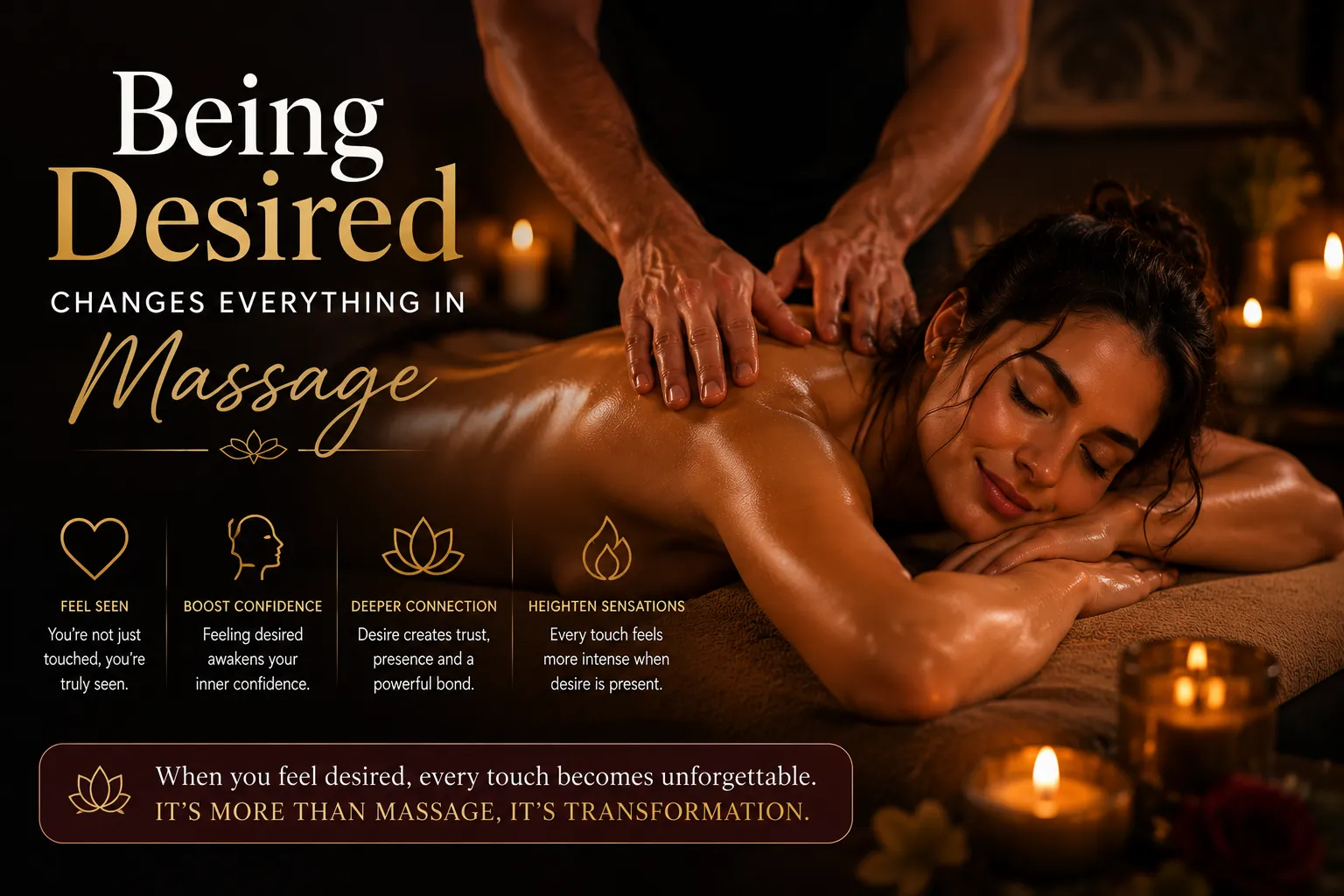
Being desired can alter the way attention feels. Instead of wondering how you look, whether you are responding correctly or what someone else expects, you may feel invited to inhabit the moment. That shift can be powerful, especially for an adult who spends much of life being assessed by deadlines, roles, screens and social conventions.
In a professional massage setting, however, the phrase needs care. Feeling desired is a personal experience. It is not proof that a therapist feels private attraction, an invitation to pursue a relationship or a promise that the appointment will change your confidence. The most credible version comes from focused attention, an unhurried welcome, responsive communication and the knowledge that every part of the experience remains your choice.
That distinction is the heart of this article. Desire feels most meaningful when it is not confused with obligation. Clear limits do not weaken the atmosphere. They create enough security for an adult to receive attention without guessing, performing or surrendering control.
What does “being desired” mean in a professional massage setting?
Here, being desired is best understood as a felt quality of attention. The client may feel noticed, welcomed and fully included in an adult sensory experience. The therapist can contribute through presence, warmth and responsiveness, but should never claim a private feeling that cannot be verified or use apparent attraction to blur the professional relationship.
This creates a useful separation between the experience and the story attached to it. The experience may include sustained attention, comfortable pacing, a calm voice and a sense that preferences matter. The story might be, “This person personally wants me,” or “This proves I am attractive.” A professional provider can responsibly shape the first. They should not manufacture or confirm the second.
That does not make the experience false. A professional adult massage can offer convincing attention within a clearly defined role. The frame is part of what makes the experience safe enough to enjoy.
The “desired without assumption” framework
The feeling becomes easier to understand when it is separated into five practical elements. None requires mind-reading, personal promises or a particular physical response. Together, they explain why a session can feel affirming while remaining honest and professionally bounded.
1. Being noticed
Being noticed means that the provider pays attention to the person who actually arrived, not an imagined generic client. They listen to preferences, notice practical comfort and remember the consultation. This differs from scrutiny, which asks whether the body meets a standard. Attentive presence asks what will help this person feel comfortable and informed.
A respectful provider does not grade weight, age, scars, hair, disability, fitness or physical response. A characteristic that affects safe positioning, product choice or pressure can be discussed neutrally and only when required.
2. Being welcomed
A welcome begins before contact. Clear directions, a discreet arrival process, a clean room and an unrushed introduction all communicate that the appointment has been prepared for rather than squeezed into a gap.
Warmth should never depend on compliance. A client who asks a question, changes a preference or excludes an area should receive the same courtesy as someone who accepts the original plan. Otherwise the welcome is conditional, and conditional warmth quickly becomes pressure.
3. Receiving responsive attention
Responsive attention means that feedback changes what happens. If the client asks for a slower pace, less pressure, a different product or a pause, the provider adjusts without defensiveness. The response demonstrates that the client is not simply being taken through a script.
Research involving romantic partners has linked perceived responsiveness with sexual desire, partly through feeling valued or special. That finding is relevant only as background, not as proof about professional massage. A paid appointment is not a romantic relationship, and the research should not be transferred as though the two settings were equivalent. Its useful lesson is narrower: people often experience attention differently when they feel heard and understood.
In professional practice, responsiveness must stay observable. Vague claims about chemistry or intuition are less reliable than a provider who listens, checks and adapts.
4. Retaining choice
Focused attention can feel intense. Choice keeps that intensity from becoming coercive. The client decides what is welcome, can revise an earlier preference and does not need to justify a pause or stop.
The freedom to say no is not separate from feeling desired. It is one of its foundations. Attention feels more personal when agreement is genuinely optional because the client knows they are being responded to rather than managed.
Choice also removes pressure to produce a certain reaction. Quietness, conversation, uncertainty or no noticeable response can all occur. None is permission to depart from the agreement.
5. Leaving without obligation
A professionally contained experience has a clear ending. The provider allows time to settle, restores ordinary communication and does not imply that the client owes emotional closeness, a repeat booking or contact outside agreed channels.
This final element is easily overlooked. An experience may feel attentive while it is happening but become uncomfortable if the ending creates ambiguity. Clear closure protects the memory of the session because it confirms that the warmth was not a tactic for gaining access to the client’s private life.
Why being desired feels different from being evaluated
Modern London life contains many forms of evaluation. A professional is measured by output, dating profiles compress personality into images and prompts, and social media encourages comparison. The body can begin to feel like a continuing project.
An adult massage appointment can feel different when it removes the need to impress. There is no audience to win, no clever response to produce and no public image to maintain. Attention can stay with immediate preferences rather than social performance.
This is where body neutrality is often more useful than forced positivity. A client does not have to declare that every part of their body is beautiful before receiving respectful care. They can simply allow the body to be present without grading it. Neutral acceptance may feel more believable than exaggerated praise.
The shift is modest but meaningful: from “How am I being judged?” to “What am I noticing?” It may create a temporary sense of ease. It should not be advertised as a permanent cure for low self-esteem, body-image distress or relationship difficulties.
Professional attention is not personal attraction
The strongest boundary in this subject is also the easiest to blur. A therapist may be warm, attentive and skilled at creating an adult atmosphere. Those qualities belong to the professional service. They do not establish private attraction or mutual romantic intent.
This matters because personal attraction carries assumptions that a booked service does not. It may imply reciprocity, exclusivity, future contact or emotional availability. None should be inferred. The provider’s role is to deliver the agreed experience respectfully, not to validate a fantasy by misrepresenting personal feelings.
Honesty does not require a cold manner. Warmth can be genuine as warmth, and focus can be genuine as focus. The clearer the distinction, the less energy the client spends decoding the relationship.
If a provider encourages dependency, suggests a secret relationship, uses affection to obtain extra payment or treats boundaries as evidence of rejection, step back. Those behaviours do not create meaningful desire. They exploit ambiguity.
Why boundaries can make attention feel more vivid
Boundaries are sometimes described as restrictions, but in a sensory setting they also create definition. A picture is easier to see because it has an edge. An appointment becomes easier to enter when the scope, timing and choices are understandable.
Before the session, the client should know the service format, duration, price, location arrangement and general scope. They should be able to ask what clothing, draping, products and contact are involved without being made to feel awkward. Excluded areas and stopping language should be clear.
During the appointment, consent continues. Useful operational benchmarks appear in the UK National Occupational Standard for body massage. It calls for advance consultation, documented agreement, protection of modesty, clean working methods, individual adaptation, wellbeing checks and appropriate action if discomfort develops. Those safeguards remain relevant even though an adult service has its own distinct scope.
The NHS explains valid consent in medical care as voluntary, informed and given by a person with capacity. Massage is not medical treatment, but the principles offer a useful ethical test. Agreement obtained through pressure, surprise or missing information is not a strong foundation. A client must remain free to change their mind.
When these conditions are present, attention can become more vivid because less mental effort is spent monitoring risk. The boundary does not manufacture desire. It protects the conditions in which a client may experience focused attention on their own terms.
Desire should never become a performance target
A title about being desired can create another demand: the client may feel expected to look confident, relax quickly or show obvious enjoyment. That reverses the purpose of the experience.
A professional appointment should not be judged by a single physical or emotional outcome. Bodies respond differently across days, environments and situations. Tiredness, medication, stress, temperature, unfamiliarity and ordinary individual variation can influence what someone notices. No response proves openness, and no lack of response proves failure.
The provider can make feedback easy by using neutral questions:
- “Is this pace comfortable?”
- “Would you prefer more or less pressure?”
- “Would you like a pause?”
- “Is the room temperature suitable?”
- “Shall I continue within the plan we agreed?”
These questions ask about choices rather than demanding praise. They also give the client language that is easier to use than a vague request to “relax”.
The client can answer briefly. “Slower”, “lighter”, “avoid that area”, “pause” and “stop” are complete instructions. A provider should not negotiate against them.
How to choose an experience that feels attentive rather than theatrical
Promotional language can make every appointment sound transformational. More useful evidence appears in the provider’s response to ordinary questions. Clear answers reveal whether attention exists before the session begins.
For someone considering Tantric Massage in London, the first task is to identify the service that actually matches their interest. Similar-sounding labels can describe different formats, so a broad brand promise is not enough. Read the relevant service information, compare current profiles and ask for clarification before travelling.
A claim about the most popular Tantric Massage parlour in London cannot tell you whether the provider suits your boundaries, preferred area or communication style. Popularity is not a substitute for written confirmation, transparent pricing, clean facilities or a respectful consultation.
The same principle applies when comparing a supposed best tantric studio in London with a quieter independent option. “Best” depends on the individual brief: incall or outcall, Central London convenience, privacy, room conditions, therapist fit and the precise service requested.
Use the therapist directory as a starting point, then confirm the current therapist, location, date and format with the booking team. Profiles and listed areas can change, so current confirmation matters more than an old screenshot or third-party description.
Questions to ask before booking in London
A short, direct conversation can protect anticipation while removing avoidable uncertainty. It need not feel clinical or awkward.
Ask the booking team:
- What is included in the named service, and what is outside its scope?
- Is the appointment incall or outcall for the required date?
- Who is the confirmed therapist, and is the profile current?
- What are the precise duration and complete price?
- Which postcode or area applies, and when are full directions provided?
- Which oils, gels or fragrances are used?
- How are allergies, skin sensitivity, injuries and current treatment handled?
- How can the client pause, modify or stop the appointment?
- What privacy and hygiene measures are followed?
Check the current prices and durations rather than relying on an older article. If the written information and the booking answer differ, ask which is current before paying or travelling.
Incall and outcall create different kinds of privacy
Being the centre of focused attention requires an environment in which interruption is unlikely. Incall and outcall can both provide that, but the practical risks differ.
At an incall location, confirm the address process, entry instructions, room privacy and arrival time. Do not assume every therapist works from every listed area.
With outcall, the client controls more of the environment but carries more responsibility. Check hotel visitor rules, or manage pets, deliveries and other occupants at home. Discuss linen and product requirements beforehand.
Neither format is inherently more attentive. The right one is the format that reduces distraction and supports the agreed boundaries for that client on that day.
What contemplative practice can and cannot add
Tantra Yoga may use breath, posture, concentration or philosophical study, depending on the tradition and teacher. It is not another term for a paid massage appointment, and participation in one does not establish expertise in the other.
A simple attention practice can still be useful before a booking. The client might take a few quiet breaths, notice where they are holding tension and identify one practical preference to communicate. This is preparation, not proof of spiritual advancement or a method for forcing a desired state.
Be cautious when a provider uses spiritual language to discourage questions, reinterpret discomfort as necessary growth or claim authority over what the client “really” needs. Any contemplative framing must leave ordinary consent intact.
After the appointment, keep the meaning proportionate
Focused attention can linger. A client may feel affirmed, thoughtful, stirred or entirely ordinary. None of these reactions needs to become a life-changing lesson.
A brief reflection can separate what was genuinely useful from the story created around it:
- Did the provider explain the service clearly?
- Did requests lead to immediate adjustment?
- Did the attention feel welcoming rather than evaluative?
- Were limits respected without a change in attitude?
- Did the ending feel clear and unpressured?
- Would the same format suit another appointment?
The answers reveal more than asking whether the therapist “really” desired the client. They identify the parts of the experience that can be observed and chosen again.
If the appointment brings up persistent distress about self-worth, body image, relationships or sexual wellbeing, massage should not be treated as therapy. COSRT states that registered psychosexual and relationship therapy is talking therapy and does not involve touch. A GP or appropriately qualified, registered therapist is the better route for concerns that need assessment or ongoing support.
Red flags that turn attention into pressure
Some behaviour can look flattering at first while weakening professional safety. A credible provider should make the client feel freer to choose, not more indebted or confused.
Pause before booking, or end the interaction, if the provider:
- promises personal attraction or romantic involvement as part of the service;
- will not explain scope, boundaries, price or duration clearly;
- treats hesitation as an insult or tries to bargain against a limit;
- claims that discomfort is necessary for emotional or spiritual healing;
- guarantees confidence, relationship repair or a specific physical response;
- pressures the client into private contact outside established booking channels;
- makes demeaning comments about appearance or compares the client with others;
- changes the agreed provider, location or service without informed agreement.
Feeling desired should not cost the client their judgement. If the atmosphere depends on ignoring obvious concerns, it is not a trustworthy experience.
Frequently asked questions
The following answers address common questions about desire, professional attention and adult massage appointments in London.
Can a professional therapist genuinely make me feel desired?
A therapist can create conditions that some clients experience as desirable or affirming, including focused presence, warmth and responsive communication. They cannot guarantee your emotional response or honestly prove private attraction through a paid appointment. Judge the service by observable respect, clarity and adaptation rather than a personal claim.
Is feeling desired the same as feeling attractive?
Not necessarily. Attractiveness can feel like a judgement about appearance. Feeling desired may arise from being welcomed, attended to and treated as someone whose preferences matter. Experiences differ, and neither feeling should be promised as a guaranteed result.
Do clear boundaries make the session less authentic?
No. Clear boundaries explain what is available, what is excluded and how choices can change. They reduce the need to guess. An adult atmosphere can remain warm and engaging while the professional role stays fully understood.
What if I do not react in the way I expected?
There is no required reaction. You may feel relaxed, alert, self-conscious, neutral or something else. A responsible provider will not treat a particular physical response as the measure of success or use it as permission to change the agreed scope.
Can this kind of massage improve self-esteem?
Some adults may leave feeling affirmed, but a massage cannot guarantee lasting confidence or treat low self-esteem. If body image or self-worth causes continuing distress, consider discussing it with a qualified healthcare or mental-health professional.
How do I protect my privacy when booking?
Use the provider’s published contact route, ask how personal information is handled and confirm what will appear in messages or payment records if that matters to you. For an outcall, check hotel or building access. Do not send more personal information than the booking genuinely requires.
What should I confirm on the day?
Confirm the therapist, start time, duration, total price, incall or outcall arrangement and precise location process. Revisit the service scope and any exclusions during consultation. Current confirmation prevents an old profile or earlier message from being treated as a permanent promise.
The most convincing desire leaves room for a no
Being desired can change the emotional texture of an adult massage because it replaces evaluation with focused, chosen attention. Its most credible form does not depend on pretending that a professional appointment is a private romance. It comes from being noticed without being graded, welcomed without conditions, responded to without mind-reading and allowed to leave without obligation.
The paradox is simple: attention can feel more vivid when the limits are clear. A genuine no protects every yes. A pause does not spoil the atmosphere. An ordinary question does not weaken connection. These freedoms allow the client to receive attention while remaining fully themselves.
If this is the kind of clearly defined, private experience you want to explore, send Tantric Massage London an enquiry to verify who is available, where the appointment takes place, which format applies and the complete cost before deciding.










Leave a Reply